
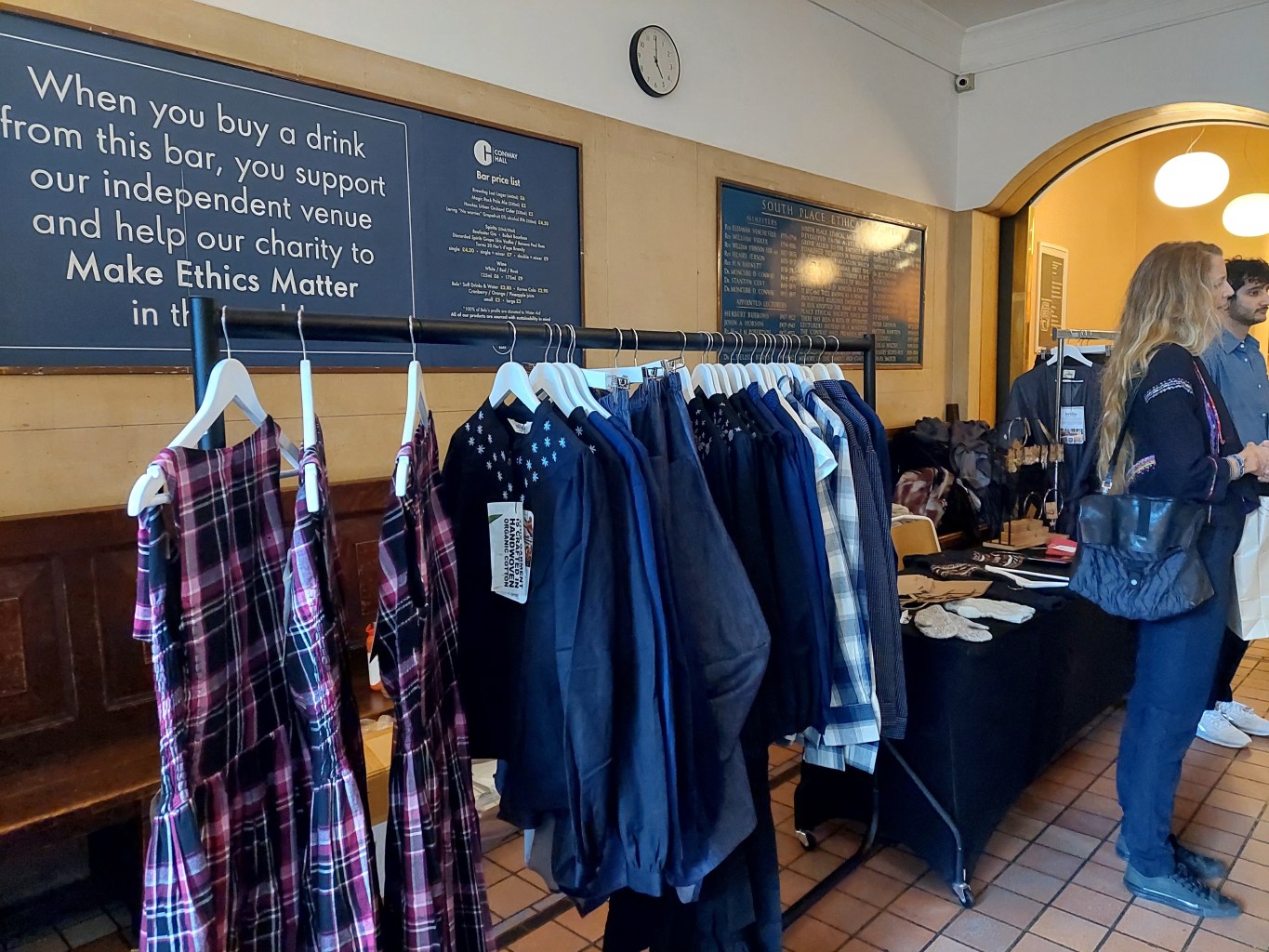
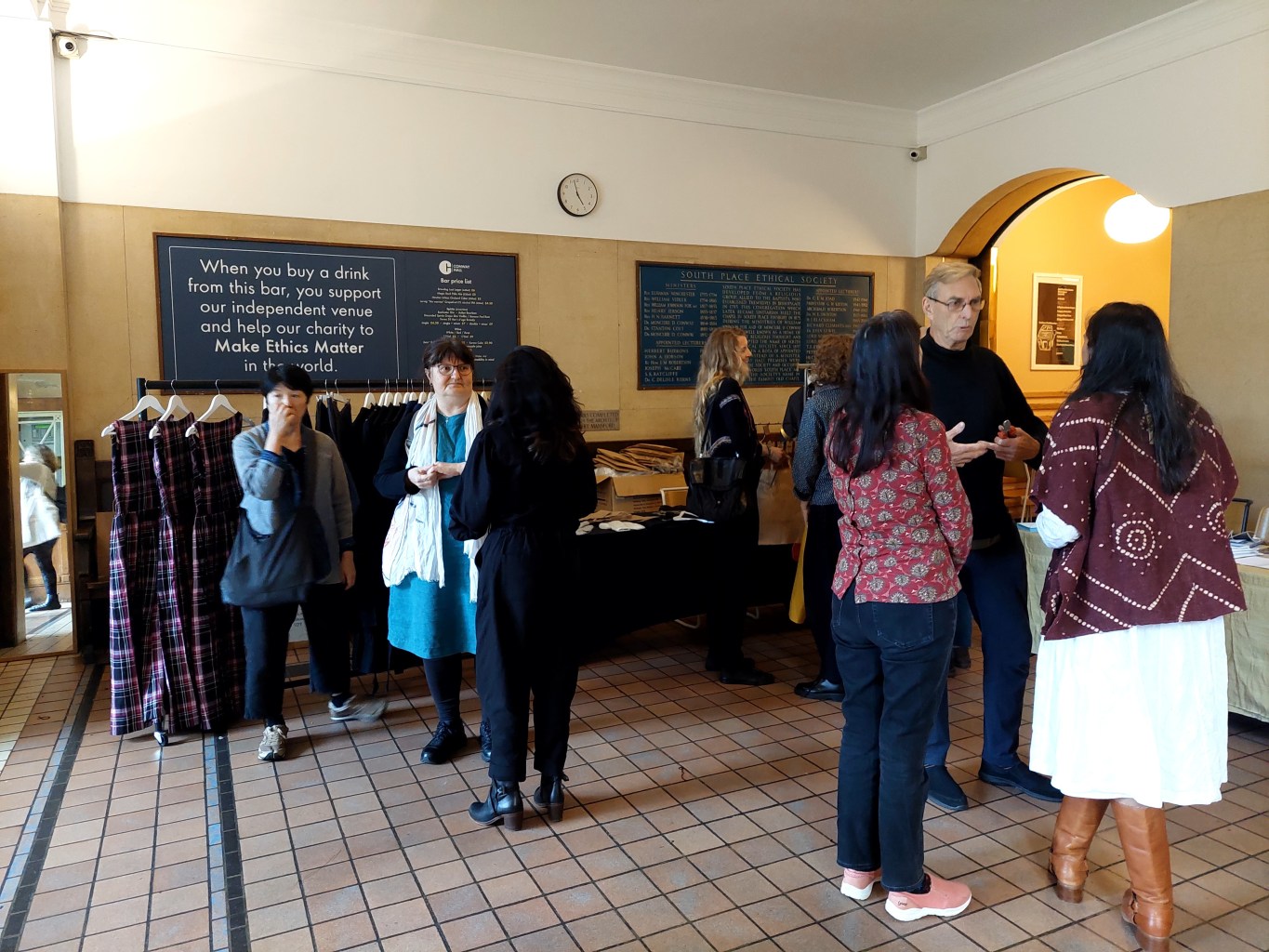
Tucked away in quiet Red Lion Square in central London, Conway Hall hosted Crafting Regenerative Fashion & Textile Futures on 18 September 2025 – a landmark event by Fashion Declares, Indilisi, and Selvedge Magazine. Taking place as part of the inaugural London Textile Month and London Fashion Week – just two days before Sustainable Fashion Week began across 34 UK locations – the event gathered 20 speakers and a full audience for seven hours of insights into how fashion can become truly regenerative.
Rather than dwelling on the industry’s problems, the panels focused on solutions. Craftsmanship was celebrated as a powerful tool to address social injustice, supply chain abuses, transparency gaps, and resource exploitation. With Safia Minney MBE FRSA – founder of People Tree, Indilisi, REAL Sustainability, and Fashion Declares – chairing, and Polly Leonard (Selvedge Magazine) co-curating, the event combined inspiring talks with hands-on pop-ups of artisanal clothing, accessories, and books (Quickthorn Books Inc.), offering tangible examples of alternative ways of doing things.
RETURN TO THE CRAFTS
As fashion – particularly luxury – faces unprecedented disillusionment and a creative crisis, Carry Somers, director of League of Artisans, Pachacuti, and co-founder of Fashion Revolution, who premiered her book The Nature of Fashion: A Botanical Story of Our Material Lives (Chelsea Green Publishing UK) earlier in September, reminded the audience that luxury “started off as being an active word and then, as centuries progressed, it became more passive”. Returning to craftsmanship to reinvent luxury is hardly a contemporary epiphany – it is about reclaiming what luxury originally was.
“We’ve lost the connection with where things come from,” says Somers. This is a systemic issue. For the first few years when Somers and her team were working on the Fashion Transparency Index, brands would not disclose where their materials came from. The Crafted Report by League of Artisans, published in June 2025, which she co-created, addresses the transparency gap in environmental and social reporting for artisan production in the fashion and homeware sectors, especially among well-known brands in luxury, affordable luxury, and fast fashion. The report combines first-hand experience with expert analysis and concrete global data. Its highlight is establishing a firm connection between fair pay and environmental impact – proving that sustainability must be approached as a holistic modus operandi rather than a “divide and conquer” resource-allocation project.
At the core of sustainability principles lies the objective of minimising resource use. Somers recalls her three-year EU geo-traceability project, where she was part of a team tracing entire supply chains back to artisans and processes. She discovered that one Panama hat requires the equivalent of 13 days’ worth of drinking water across the production cycle, compared with a cotton hat requiring the equivalent of 825 days. “We started to realise not just the importance of transparency and traceability – bringing visibility to these processes and their impact – but also how much fibres and materials matter when it comes to choosing the right one.” By “right materials”, she means fibres such as raffia, which trap carbon in the soil – a subject she expands upon in her highly anticipated book.
THE WALLS TO BREAK

“We have a multiplicity of problems, rooted in the fact that we are still bound to a single system of fashion – how we evaluate success, what success means – which is exponential growth on a finite planet with finite resources,” says Dr Sass Brown, ethical fashion educator, writer, researcher, designer, and the founder and driving force behind Clothing Ethics. “We need to revolutionise the systems and the value chain, because the way we work within these systems simply doesn’t work.”
The current fashion system benefits the few, exploits the marginalised, and keeps consumers as ignorant and enchanted as possible. The ultimate battle for a consumer often comes down to ease of purchase and price, driving a race to produce cheaper and compensate with quantity. The biggest players grow faster, while smaller or ethical brands must work doubly hard without guarantee of reaching the right audience.
“The craft and social enterprise movements face huge barriers to entering the market, but offer real alternatives to slowing down fashion and redistributing wealth – essential to create post-growth pathways for fashion, “ says Safia Minney. “We need to frame innovation and progress through the lens of wellbeing, social justice and access to resources – recognising that a just transition will not happen until we accept just how dysfunctional and racist the current system is.”
Close cooperation based on shared values – or “shared responsibilities” in the words of Sophie Lane (SOKO Kenya) – is what it takes to begin pushing down entry barriers and allow local players and regional craftsmanship to gain presence on the international market. “Less of a transactional model and more of genuine two-way relationships – brands visiting their suppliers, with much more accountability and transparency in those relationships,” says Lane.
Investing in two-way relationships that go beyond the transactional model must go hand in hand with customers learning to appreciate the craft of the product – and the whole process behind it. Take clothing: it must go through natural dyeing, handweaving, and hand embroidery – processes that require time, effort, and skill – yet these are typically the first to be unapologetically cut from current business models. Recent reports on working conditions in the luxury sector revealed that abuses occur even when customers are prepared to pay more for a product.
“We need to frame innovation and progress through the lens of wellbeing, social justice and access to resources – recognising that a just transition will not happen until we accept just how dysfunctional and racist the current system is.”
Safia Minney, MBE, FRSA, Founder of Indilisi, Fashion Declares, and People Tree
Only by supporting artisan brands and grassroots initiatives can the stewards of our Earth – who also happen to be those facing more evident and increasing struggles in the climate crisis than most consumers in cities – sustain their heritage and livelihood. For them, producing in a vegan and nature-friendly way is not a shiny new objective, but the continuation of the only method they and their forebears have been perfecting and practising for decades, sometimes centuries.
Indilisi, the new craft start-up and sponsor of the event, aims to bring this ethos into the fashion system, and ultimately to the end customer – many of whom may never have worn handwoven fabrics.
After all, it does not get more meaningful – and luxurious – than wearing something where every thread, weave, dye, and finish has been shaped by hand.
And while craftsmanship is widely agreed to be the way to change the current fashion system, there is disagreement about whether and how to build on top of it. “I’d love to think we can find a way of bridging that cross-over between craft and scale,” says Jo Dawson of HD Wool. “Somehow we need to identify what drives craft at scale without losing the essence of craft.”
Dr Sass Brown disagrees: “Scaling is one of the challenges and problems. I don’t think producing more is the answer.” While it is up to each individual to decide which position resonates more, it is worth noting that these perspectives come from two entirely different standpoints – that of a producer, and that of a researcher and creative – both equally concerned.
THE REMAKE OF BUSINESSES


left to right: Safia Minney, Oliver Scutt, Bel Jacobs
Ending the shortcomings, omissions, and abuses in the global fashion supply chain requires policy change and a fundamental restructuring of the way businesses are designed to operate. “Those producing less impactful products with higher social impact are competing with this race to the bottom, with synthetic garments made in sweatshops,” says Minney.
The final panel featured Erinch Sahan (Associate Director, Investment, Joseph Rowntree Foundation), Oliver Scutt (Legal Director at Bates Wells), and Bel Jacobs (writer and speaker on climate justice, animal rights, and new fashion systems – Co-founder of Fashion Act Now), who discussed with Minney recent changes in business ownership models, the fundamental role lawyers play in policymaking at both governmental and entrepreneurial levels, enforcing sustainability efforts through binding legal provisions, and how the only reasonable way to grow is to actually de-grow.
“If we’re going to transition, we’re going to need to ask deeper questions about how we have designed businesses,” says Erinch Sahan. New technologies in both production and distribution – of products, services, and ultimately information – hold great promise in facilitating systemic change. New business ownership models, such as co-ownership, steward-ownership (where controlling shares sit with a purpose trust or foundation that embeds a long-term mission and reinvests profits), hybrid cooperatives, and nature-based governance are all emerging. “The fashion sector is at the heart of it, because there are going to be new innovations in the way we design products, the way we market products, and what products are for.”
“The alternatives are going to require getting into the details of who has governance rights, who has economic rights, and through that, how we design these very diverse emerging models in ways that deliberately unlock ambitious action,” continues Sahan. Actions that, until now, have been restricted for the sake of financial growth – a reality that is as disturbing as it is pervasive across every industry, not just fashion.
Minney remarks that governance structures in social enterprises – novel as they may sound – are what the fair-trade community has been pioneering for the past 40 years, finding ways to overcome “enormous financial disadvantages that creating social impact, craft, and working with low-impact materials face”, often compounded by delayed payment schedules for manufacturers.
But change is happening, not just on a global awareness level but also in hands-on entrepreneurial practice. “I know of some pioneering work that is happening through various channels around building new frameworks for SMEs which would benefit their operations and reporting mechanisms, and positively impact shareholder perceptions and valuations for the benefit of the environment and society,” says Oliver Scutt.
Companies big and small, in fashion and beyond, are starting to restructure their ownership and board models to include a director role for nature and future generations on the board that improves not just long-term strategy but also everyday operations. Scutt is leading these transformations for clients – from restructuring ownership to pressing for the Better Business Act to reform section 172 of the Companies Act so that directors’ duties are to stakeholders rather than shareholders. “This sounds like a very simple change, but actually it’s a root-and-branch overhaul of the corporate operating model under English law,” says Scutt.
The White Paper by Fashion Declares and Bates Wells provides “a carrot-and-stick approach” to enable UK policy changes that tangibly endorse better business practices, benefiting all sizes of fashion players. Initiatives include removing the de minimis customs loophole, adapting taxonomies like Sweden’s lower VAT on fossil-free textiles, funding recycling infrastructure via the EPR framework, and introducing digital product passports.
THE STATE OF EMERGENCY
Given the current situation, humanity can no longer afford to treat environmental stewardship as optional. “We really are past the precipice now. I was saying that we were on a precipice at the beginning of Fashion Act Now in 2020 – it’s past that. We’re really, really facing a devastatingly changed world,” says Bel Jacobs, recalling her early days working as a fashion editor, when no questions were asked under the light of fine dining and luxury press trips. Even then, she felt something about the system was off.
“How the fashion industry manipulates values is one of the reasons it is so slow to change, despite all the evidence to the contrary. It is a wizardry of tricks”.
Jacobs had a few defining moments of moral shock; the first one came with Rana Plaza. “Some of the labels that I am seeing in the hands of the bodies are the same labels I’m putting on my pages,” says Jacobs. The guilt was too heavy, and she left her role.
This is where ‘radical, almost unimaginable ideas of how we transform fashion to put life over profit’, to quote Emma Håkansson, author of Total Ethics in Fashion (Hardie Grant Media) and founder of Collective Fashion Justice, should find their way into the minds of those who still claim not to care.
Jacobs’ second shock came while watching a documentary on the leather industry in China, in which the callousness of treatment and the brutality of deaths of intelligent animals shook her to the core. “It’s not just enough to focus on sustainable fashion and doing good. Something is seriously awry with an industry that can ignore Rana Plaza and then ignore what happens to other sentient beings in the supply chain to this extent… I saw a handbag made of leather and I remembered what I saw in that documentary and I thought: the trickery is often off the charts.”
Then came the climate crisis. Together with Extinction Rebellion Fashion, Jacobs held a funeral for the fashion industry on the steps of the British Fashion Council, where Minney delivered “the most incredible speech”. “We just put out a couple of Facebook posts; we thought there might be 30 people, max.” Instead, they were joined by a massive, outraged crowd.
“I think everyone in this room really needs to talk to others outside the bubble about why you do what you do and how important this horrible situation is that we find ourselves in. We will take up the solutions if we are shocked enough and if we understand the true costs of everyday practices.”
Of course, we wouldn’t be ourselves if we didn’t ask how to make vegan and low-impact fashion more attractive to regular customers. According to Jacobs, patience, calm, and compassion are key, supported by solid data. “If I am going into a crowd of meat-eaters I am not going to yell at them. I would say: I was one of you once, I understand. But I’ll choose just a couple of key facts and I’ll talk to them about those.”.”
And sometimes those facts are hard to ignore. Take leather: animal agriculture is the biggest killer of indigenous land defenders, and 80% of starving children live in countries that grow food for the global north. “Leather impacts the world and its beings in so many ways. If you don’t care about the animals, you’ve got to care about the children. If you don’t care about the trouble, you’ve got to care about the indigenous land defenders. Something there will resonate with you.”
“We will take up the solutions if we are shocked enough and if we understand the true costs of everyday practices.”
Bel Jacobs, FRSA, Co-founder of Fashion Act Now; Founder of The Empathy Project; Writer and Activist
The goal is to open people up to what sometimes ends up being a completely different set of information and perception than what they have been systematically fed. And once those doors are open, the picture is so hideous that some will insist on looking away, while others might feel alarmed and obliged enough to stop contributing to the problem and start being part of the solution. “Every conversation has the potential to change hearts and minds – but you have to do it with compassion, especially for those trapped within the old systems,” says Jacobs.
That brings us back to the words of Daniel Mawuli Quist, Creative Director of the OR Foundation, earlier in the day, when he spoke about circular fashion in Ghana – a vast topic for another piece. His words remain a key takeaway from the event: “Get out of your comfort zone. (…) Even if it’s painful and involves a lot of back and forth.”
A CALL FOR A CULTURAL SHIFT

Scutt notes that systemic change requires attention not only to infrastructure and governance, but also to downstream effects on consumers’ health. “There is a growing online safety crisis in fast fashion due to the dark pattern algorithms and gambling techniques which fast fashion companies deploy to drive sales – and this is particularly affecting younger demographics. This urgently needs to be addressed.”
And while the mental health of consumers is undoubtedly exploited by fast and ultra-fast fashion, it is doubly disturbing to recognise that these same anxieties push people towards the instant and deceitful gratification of buying cheap clothing and accessories. Fundamental change is therefore essential. Amelia Twine (Single Thread, Sustainable Fashion Week) frames it as “changing the demand at the bottom”. “I wake up every day feeling a constant sense of urgency,” she says. “There is an alternative system to what it is.”
The alternative system of “de-growth” – an “itchy” phrase, in Jacobs’ words – already includes activities many people practise without identifying with activism: recycling and upcycling, returning waste, or simply repairing clothes instead of discarding them. These are the principles embodied by Sustainable Fashion Week. “The question we all have to ask ourselves now is: what is fashion in a climate emergency? What is fashion in a time of ecological breakdown?” says Jacobs.
“We have to go through a complete cultural revolution in the value of clothing. We’ve gone from my mother’s generation, who would spend three months’ wages to buy a coat that had to last 10 to 15 years, to something we buy on a whim, may never wear, and throw away without a thought,” says Dr Brown.
“We have to go through a complete cultural revolution in the value of clothing.”
Dr Sass Brown, Ethical Fashion Educator, Writer, Researcher, and Designer; Founder of Clothing Ethics
“Craft has a huge part to play in this, because it will take back some of the materials that we are now so blithely throwing away and turn them into clothes that we need, value, and care for,” says Jacobs. “We also want a clothing system that truly values all life on this planet. When I say all life, I don’t just mean the life we find charismatic or useful. I’m talking about the pigs, and cows, and chickens and everyone. That is the paradigm shift we need to see: a mindset shift. A cultural shift.”
***
This event is part of the inaugural London Textile Month and London Fashion Week.
Speakers:
- Safia Minney, MBE, FRSA [chair] – Founder of Indilisi, Fashion Declares, and People Tree
- Gemma Metheringham – Founder of The Elephant in My Wardrobe
Co-curator:
- Polly Leonard – Founder and Editor of Selvedge Magazine
Guests (in alphabetical order):
- Ali Clifford – Environmental Consultant; Ethical Marketing & Coach at Incredibusy
- Bel Jacobs – Co-founder of Fashion Act Now; Founder of The Empathy Project; Writer and Activist
- Dr Sass Brown – Ethical Fashion Educator, Writer, Researcher, and Designer; Founder of Clothing Ethics
- Jo Dawson – Founder of HD Wool; Co-founder of The Woolkeepers®
- Emma Håkansson – Founder of Collective Fashion Justice; Author of Total Ethics Fashion
- Sophie Holt – Founder of Pigment Organic Dyes
- Sophie Lane – Founder of SOKO Kenya
- Kirstie Macleod – Founder of The Red Dress Project
- Daniel Mawuli Quist – Creative Director at The OR Foundation
- Jo Salter – Director of Khadi London
- Bryony Richardson – Founder & Illustrator at Palava
- Erinch Sahan – Associate Director at Joseph Rowntree Foundation
- Oliver Scutt – Legal Director and Partner at Bates Wells
- Carry Somers – Director of League of Artisans and Pachacuti; Co-founder of Fashion Revolution; Author of The Nature of Fashion
- Amelia Twine – Founder of Sustainable Fashion Week
- Madhu Vaishnav – Founder of Saheli Women