While the mainstream has been freaking out about Artificial Intelligence (AI) stealing human jobs, new roles have actually emerged to develop, operate and capitalise on AI within the fashion industry. This specific link between “the occupational categories most exposed to generative AI” and the creation of new jobs by 2030 was highlighted by McKinsey & Company as early as their 2023 report.
Fashion’s exposure to generative AI is amongst the highest globally, with AI becoming a top priority for fashion executives throughout 2024 – so much that it has displaced sustainability as their primary focus. As AI continues to evolve, the fashion industry is expected to see further diversification in job roles. These emerging jobs currently require more streamlining and specialised training. Many roles overlap, or remain ambiguous, particularly in fashion companies with no technological background yet seeking to leverage AI.
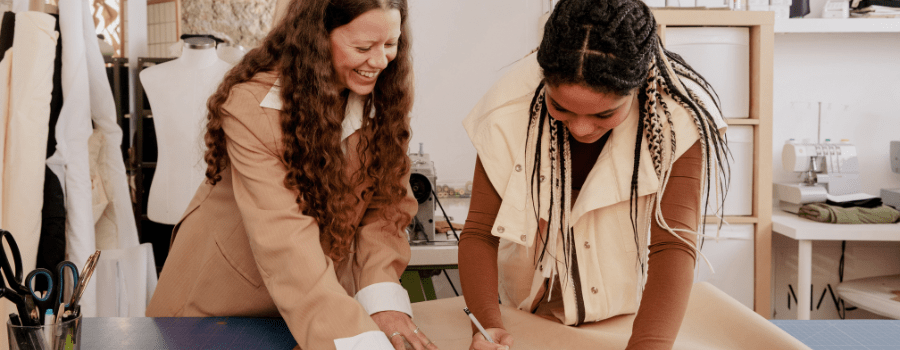
The rise of AI has increased demand for roles such as production managers, pattern makers, and garment constructors, whose expertise is essential in the back-end, i.e. researching and developing tools designed to facilitate the inevitable changes within the global fashion industry. Fashion is not an area where the human touch can be deemed redundant. Quite the opposite, so long as feelings remain central to creation and consumer response, the ‘human-in-the-loop’ model, which is weaves human intervention into the matrix of algorithms and machine learning to prevent fake facts, creepy input and even creepier output, will remain a fundamental differentiator between effective and ineffective AI tools.
In this article, we outline three emerging jobs in AI’s back-end that are laying the foundation for the future of fashion: Generative AI Researcher, AI Design Operations Specialist, and Fashion Data Analyst.
For the emerging front-end jobs, jump to this article.
Generative AI Researcher
Generative AI Researches are at the forefront of new technology. They develop tools for other AI fashion specialists, such as AI Fashion Designer, Creative Technologies, AI Design Ops, and AI Model Creator. These researches push the boundaries of AI’s creative potential, and aim to advance AI capabilities to generate or analyse fashion data. They design and refine algorithms tailored to the specific needs of the fashion industry, and focus on machine learning models, such as generative adversarial networks (GANs), that can create new designs or predict trends. Their work involves leveraging extensive datasets and a deep understanding of both fashion and machine learning. This role is essentially one of constant creation and experimentation, using generative techniques to produce diverse and unique outputs.
Companies such as VopplAR and Style3D develop machine learning algorithms, and create design solutions based on each brand’s aesthetics and commercial needs. Their research and development results in tools that enable product editing and optimisation, virtual try on, and 3D rendering.
Job requirements: background in technology, and/or confirmed expertise in machine learning, deep learning, and AI programming languages (Python, R, JavaScript, TypeScript, C++ etc.). Strong familiarity with generative techniques like GANs, diffusion models, or reinforcement learning. Knowledge of fashion trends and aesthetics to align AI-generated designs with market demands.
Soft skills: Ability to see both the big picture and the finer details. Strong problem-solving skills, analytical mindset, and exceptional creativity.
AI Design Operations Specialist (Design Op)
While Researchers develop cutting-edge AI models, Design Ops make sure these technologies are effectively utilised by creative teams across the industry. Although technically a back-end role, it also has strong front-end characteristics. On one hand, Design Ops build and manage the infrastructure alongside the researchers. On the other hand, they work directly with AI Fashion Designers, and teach them how to use these tools effectively while gathering and analysing their feedback. Implementation and optimisation are key objectives. Design Ops make sure that AI tools meet market needs and are of assistance for designers. They connect AI technology and creative teams in areas of trend forecasting, design generation, and operational efficiency. They serve as implementers, trainers, and ultimately, the SOS line.
Companies such as The Fabricant and Yoona.ai offer tools that accelerate fashion’s creative and commercial processes, reducing timelines from weeks to minutes. Their services range from digital product creation to multichannel digital asset implementation.
Job requirements: Proficiency in data management, workflow automation, AI platforms and tools used in fashion design (e.g., CLO 3D, GANs, MidJourney, DALL·E). Knowledge of data processing, automation tools, and workflow management systems. Familiarity with APIs and integrations for creative software. A working knowledge of fashion design to align technical solutions with creative goals.
Soft skills: project management skills to coordinate teams and streamline AI-related operations. Solid problem solving skills and patience.
Fashion Data Analyst
The role of Fashion Data Analysts is to utilise data to inform decision-making in the fashion industry. They analyse consumer data, sales patterns, and market trends to guide strategies in design, marketing, and inventory management. In other words, they transform raw data into actionable insights for creative and operational teams. Data is gathered from vast datasets, including customer preferences, sales figures, and online interactions, such as social media activities. By leveraging AI-powered tools, Fashion Data Analysts identify patterns, visualise data, and use predictive analytics to foresee future trends and consumer demands. Fashion Data Analysts play a pivotal role in sustainability efforts as they analyse supply chain efficiency and identify areas for improvement or impact reduction. Data analysis plays a central role in inventory optimisation and waste reduction, as well as customer behaviour prediction. Additionally, they present findings in clear and actionable formats for non-technical stakeholders.
Companies like Heuritech and Stylumia specialise in trend forecasting and demand prediction, and utilise advanced AI to convert real-world images shared on social media into meaningful insights. They basically bridge the gap between supply and demand.
Job requirements: Strong understanding of statistical methods and data modeling. Proficiency in data analysis tools and languages, such as Python, R, SQL, or Tableau. Experience with AI and machine learning platforms for predictive analytics and trend forecasting. Familiarity with fashion industry metrics, such as sell-through rates, seasonal trends, and consumer demographics. Knowledge of e-commerce platforms, digital marketing analytics, and retail metrics. Ability to translate complex data into actionable insights. Advanced knowledge of data mining, data visualisation, and statistical analysis. Experience with AI applications, such as sentiment analysis or image recognition, to derive insights from social media or visual platforms. Understanding of the fashion product lifecycle, from concept to sale. Awareness of consumer behaviour and purchasing trends in different markets.
Soft skills: Strong analytical thinking and pattern recognition. Creative and problem-solving skills to address challenges like inventory misalignment or trend misprediction. Ability to think both critically and creatively.
Discover more from Vegan Fashion Repository
Subscribe to get the latest posts sent to your email.