
Updated 3 April 2025 (following official Copenhagen Fashion Week announcement)

2025 is expected to be a year that shapes business objectives for the years to come. But will it, though? The question of whether fashion is facing a sustainability crisis, as catchy as it sounds, remains quite unfounded—because to have a crisis, there must first be a peak from which to fall. And fashion does not appear to have climbed high enough on the sustainability ladder to warrant a legitimate downfall. But it certainly stands at a crossroads.
Sustainable fashion is going through a difficult moment. According to McKinsey & Company and The Business of Fashion, many brands have fallen short of their sustainability promises in 2024 and 63% are now behind on their 2030 decarbonisation goals. Meanwhile, apparel consumption is projected to rise by 63% to 102 million tonnes by 2030. This, combined with a shift of global business priorities that show little sight of incorporating tangible environmental commitments, along with a recent spate of sustainability scandals, makes it increasingly difficult for one to remain optimistic about maintaining the existing sustainability agenda, let alone advancing it.
The Green Illusion
Fashion, however, is not a passive subject of this shift though. If anything, it is the industry’s longstanding passiveness in implementing long-term solutions in the supply chain management that has fundamentally contributed to this peculiar set of circumstances. The green rush has benefited the greenwashing brands far more than it has the planet. This exact argument was cited by the Dutch House of Representatives in its February 2025 proposal to lift the national surcharge on single-use plastic packaging (imposed across the Netherlands in July 2023), claiming that the policy had only served businesses and had not led to a decrease in plastic waste1.
Moreover, while businesses were given guidelines, they were allowed to set their own prices for plastic packaging and containers. Their businesses would appear greener—whatever that entailed—but it was consumers who covered the costs. Many were quite happy to, as the charges were relatively small and created the impression that they were contributing to something ‘green’. Meanwhile, the plastic waste stream continued to flow pretty undisturbed. Sounds familiar?
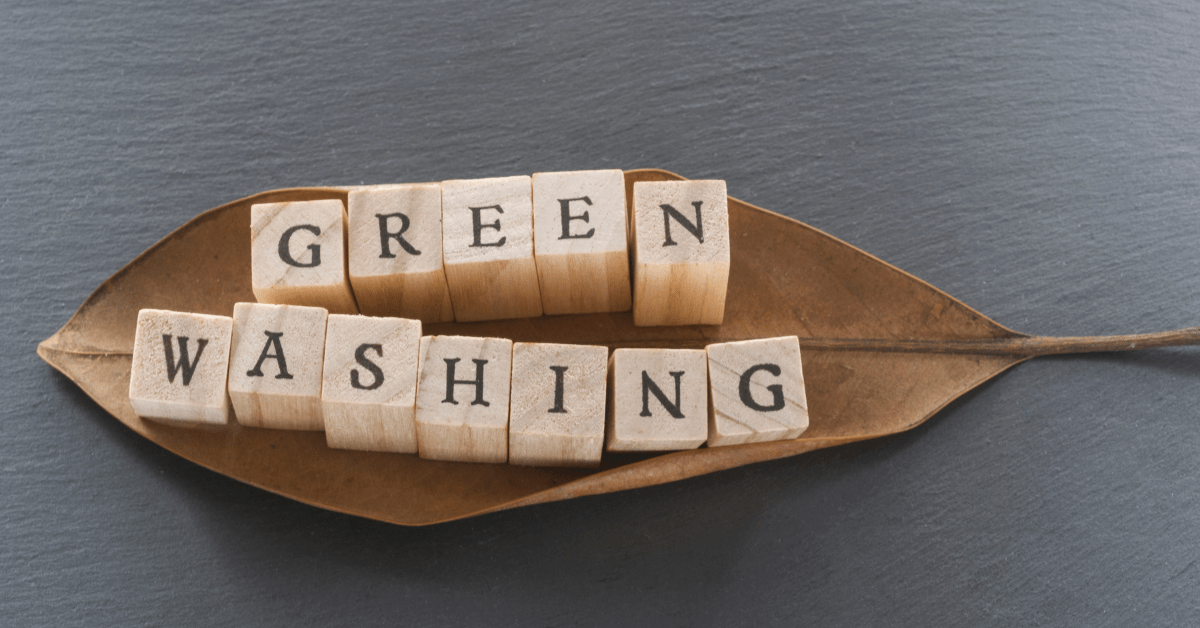
Even though sustainability has only gained a tangible traction in fashion over the last two decades, mainstream brands have managed to develop quite a repertoire of shortcuts and greenwashing tactics to capitalise on the budding consumer consciousness. From greenlabelling (making misleading claims about a product’s ‘green’ qualities) and greenlighting (highlighting a brand’s most sustainable aspects while ignoring the rest) to greencrowding (faking sustainability until they ‘make it’—but not worrying too much about it), greenrinsing (constantly shifting sustainability targets), greenshifting (placing the responsibility—and consequences—of ‘green’ choices onto consumers), and ultimately greenhushing (staying silent on sustainability altogether), the speed and intensity with which the industry has moved from greenlabelling to greenhushing is, sadly, remarkable.
Where there is demand, there is supply, and the lack of regulation has played a major role in this as well. While the Greenwashing and Green Claims Directives aim to limit the misuse of vague sustainability-related terms (‘green’, ‘eco’, ‘eco-friendly’, ‘responsible’, etc.) from 2027 onwards, there is a growing sense that instead of progressing towards more accountable sustainability practices, we are witnessing a regression—one that could undermine even the smallest achievements of the last decade. But how small are those, really?
In early March, just as the fashion week marathon from early January to mid-March was wrapping up, anti-greenwashing expert Tanja Gotthardsen filed a formal greenwashing complaint against Copenhagen Fashion Week and seven participating brands: Baum und Pferdgarten, Berner Kühl, Forza Collective, Herskind, OpéraSport, Stine Goya, and Won Hundred. These brands were accused of failing to provide sufficient evidence to back their sustainability statements.
The irony is, Copenhagen Fashion Week was the first fashion week to impose any sustainability rules at all. Berlin Fashion Week and London Fashion Week have adopted Copenhagen’s sustainability criteria in 2024, which have been regarded as ‘best in practice’ and a bright beacon within the global fashion industry. As of 3 April 2025, Amsterdam Fashion Week has joined the club too, launching a one-year pilot phase to embed the Minimum Standards into its existing admission criteria, with full implementation set for September 2026.
Yet, before the fragility of these green claims was loudly questioned, a truly Hegelian plot twist had already unfolded. In Copenhagen, of all places, Alectra Rothschild / Masculina show on 28 January 2025 featured natural fur coats – upcycled, but still as natural as it gets. In an interview with Vogue Scandinavia’s Allyson Shiffman, the designer said: “I don’t agree with not using old fur coats – they’re there. Instead of making new faux fur, you might as well use used and upcycled fur that’s already here.” Four days later, on 1 February 2025, Norway—one of the last strongholds of animal fur production—officially closed its final fur farming facilities.

(faux fur)
pc James Cochrane
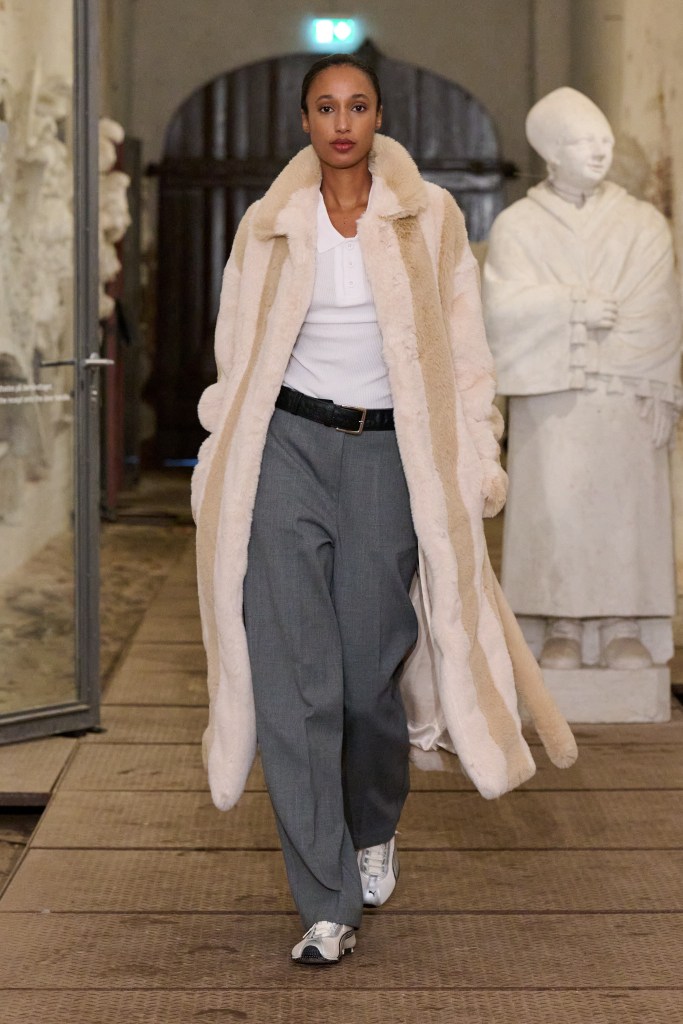
(faux fur)
pc James Cochrane

(faux fur)
pc James Cochrane

(real fur)
pc James Cochrane
One of the main takeaways from the Autumn/Winter 25/26 shows is that fur is back—and it has to look as natural as possible in colour, shape, and texture. There have been very few attempts to make faux fur appear artificial, such as the colourful dyes and playful cuts prevalent in recent years. Meanwhile, padding and corsetry were also a major theme of the season, as if our natural body shapes were no longer enough. While this has been a tell-tale sign for some designers, such as Dilara Fındıkoğlu, the widespread adoption of dramatic body augmentation begs the question: was body positivity just another trend?
More importantly, have we become so uncertain about the future that we are now looking to the distant past —cherry-picking its most stereotypical features—for comfort and security? Or are we so scared and insecure that we are retreating to the old ways to command power and attraction?
The Reality Check
Meanwhile, the European Union Commission is rallying against fast fashion, with countries like France leading the way and proposing 11 amendments to a bill aimed at regulating entities that ‘facilitate distance selling via digital platforms and rely on rapid collection turnover‘. However, despite being marketed under the guise of sustainability concerns, the primary objective appears to be more about shaping the business environment (‘to help EU companies grow, innovate, and create quality jobs’) rather than addressing ecological or ethical challenges.
The EU’s recent scaling down of sustainability regulations as part of the ‘Omnibus Package’ could not have come at a more troubling moment. The revised framework will limit compliance requirements to companies with more than 1,000 employees and an annual turnover exceeding €50 million, reduce due diligence checks from annually to once every five years, and—most significantly—apply mandatory risk assessments solely to direct suppliers.
2025 began with a loud bang when Transparentem, New York-based non-profit that investigates labour and environmental abuses (the same organisation that exposed human rights violations in Malaysia’s apparel factories in 2019), reported on pesticide exposure, debt bondage, and child labour exploitation within India’s so-called ‘sustainable’ cotton supply chain2 . Brands implicated in the findings include Adidas, H&M, Inditex S.A., Marc O’Polo, and Columbia Sportswear, among others. The investigation began in 2022, followed by engagement with companies in 2023, and the publication of the report in January 2025. Transparentem’s founder, Benjamin Skinner, is known for his unconventional approach—reaching out privately to brands first (before publishing the report) in an attempt to resolve the issue rather than rushing to make a scandal out of it. Yet the global fashion industry remains divided on whether—and how—to address such problems, with some companies outright refusing to respond.
Once again, the question of regulation—and its real-world effectiveness—pops up. “The systems are being set up to protect brands from liability rather than to protect workers from exploitation,” says Sarah Kent, Chief Sustainability Editor at The Business of Fashion. Tangible sustainability solutions—whether related to labour rights, carbon reduction, or environmental impact—are not being enforced where they are most needed: in manufacturing countries. They are also simply too costly, with a return on investment (ROI) that is too long-term to be taken up voluntarily.

The fashion industry is all about quick money —immediate profitability and rapid market responsiveness. Sustainable materials and ethical production methods are expensive and cumbersome to integrate into the rigid, vertically structured global supply chains that were established—and are still operating—on conventional practices. Take organic cotton, for instance. It requires labour-intensive farming and soil restoration procedures, leading to higher costs and longer production times—all while demand remains both vast and impatient.
Innovations such as eco-friendly materials and recycling technologies exist, but they are not always scalable or economically viable, particularly for smaller companies that are as visionary as they are short on investment capability. The struggle to scale sustainable innovations is evident. Swedish textile recycler Renewcell filed for bankruptcy in February 2024. It has since been refinanced and rebranded as Circulose by Altor Equity Partners, which aims to scale the technology with new financial backing. Similarly, Bolt Threads paused operations on its leather alternative Mylo—backed by Stella McCartney and Adidas—in June 2023, citing difficulties in securing sufficient investment and achieving the necessary production volumes.
In an industry that ranks as the third-largest wealth-generating sector—behind only technology, finance, and investment—it is reasonable to assume that profit is being made from the collective purchasing decisions of the global consumer base. Yet the industry’s hesitation, or rather its steadfast avoidance, of investing in long-term solutions that minimise environmental impact, reduce carbon footprints, and ensure fair labour conditions is deeply concerning, if not straightforward disturbing.
That said, there is a solid argument for this reluctance. Despite growing awareness, a significant proportion of consumers continue to prioritise affordability and trend-driven fashion over sustainability.
Which Way Forward?
That the consumer is a complicated creature comes as no surprise. For a long time, brands—fuelled by social media, the direct-to-consumer wave, and now AI-supported algorithms—have adopted a ‘tell them what they want’ approach to navigate (and manipulate) purchasing decisions. This is where greenwashing proved eerily effective. For a consumer already overwhelmed by the complexities of everyday life, buying a green-labelled T-shirt is a far easier—and thus more welcome—way to contribute to ‘something good’ than having to wade through eco-manuals.
A typical consumer learns most of what is green—or supposedly so—from the large-scale greenwashing campaigns of global fashion giants. These brands, rather than implementing long-term solutions, primarily seek to capitalise on green messaging. However, another irony is—like it or not—they have the reach to spread these messages far and wide—but the question remains: how truly effective is it?
The rapid and unchecked rise of ultra-fast fashion over the past few years has exposed just how superficial many of these green initiatives are. According to The Business of Fashion’s State of Fashion 2025 report, there exists a clear “action-intention” gap when it comes to consumers and sustainable fashion. A consumer—perhaps prompted by a semi-public declaration—may claim to support sustainable fashion and vow to avoid fast fashion, yet still have made a purchase from a fast-fashion brand in the last 12 months. Even though the survey was conducted in the United Kingdom, its global relevance is impossible to ignore—or deny.
With the exception of a handful of brands, the industry has yet to develop an ‘at-scale value proposition’ that would genuinely keep consumers loyal to ethical and sustainable fashion. Meanwhile, as both brands and consumers grow disillusioned with greenwashing, alternative consumption practices—such as resale and repair—are gaining traction.
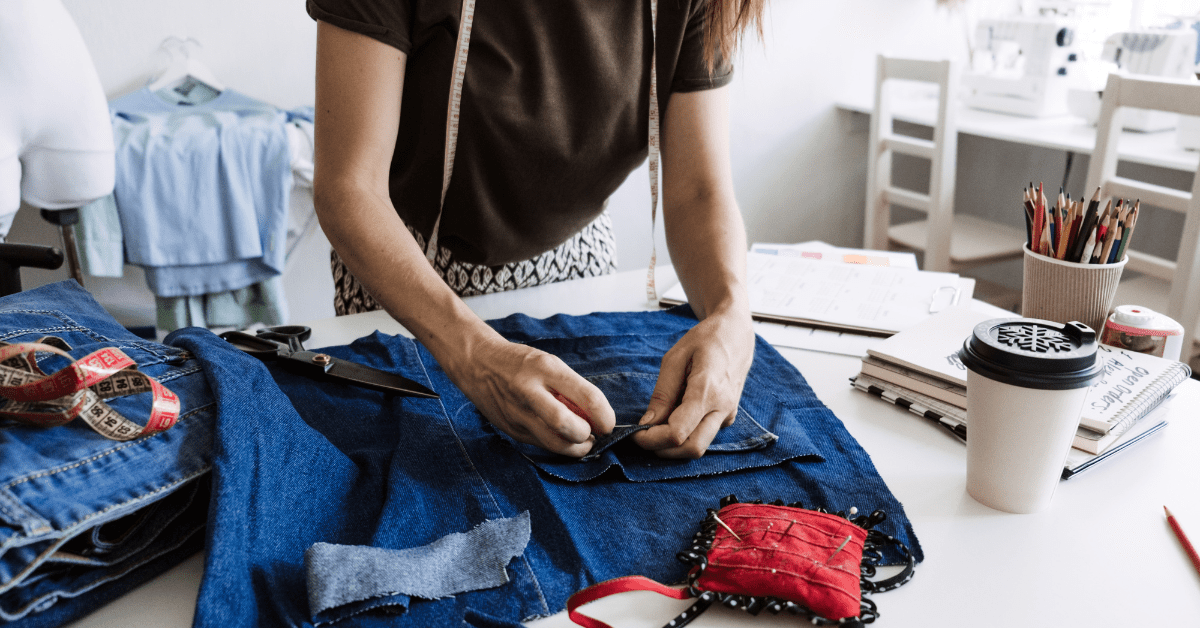
The global secondhand apparel market is expected to reach USD 367 billion by 2029, growing at a compound annual growth rate (CAGR) of 10%3, while the global clothing and footwear repair market is expected to reach USD 4.53 billion by 20334. Yet, while the resale market is only as sustainable as the quality of garments in circulation—and running a resale business comes with its own sustainability challenges—the repair market appears to offer some clear, immediate wins for all parties involved.
WRAP‘s research findings are quite encouraging, too: repairing a single cotton T-shirt instead of buying new could save over 7.5kg CO₂e—equivalent to ironing for 25 hours—while purchasing a preloved pair of jeans online rather than new could save over 30kg CO₂e, the same as making 600 cups of tea.
Several brands, particularly in the sustainable and luxury sectors, have partnered with repair services to extend product life and reduce waste. Sojo, a UK-based platform for clothing repairs and alterations, has collaborated with brands such as GANNI, Paul Smith, and Pangaia. Others, including Levi’s and Nudie Jeans, have also invested in repair initiatives, offering in-house services or partnerships with local repair businesses.
Could repair be the solution to keep brands green, and customers loyal? Time will tell whether this will evolve into a prevailing practice or merely another passing trend picked up by an overstimulated consumer base out of nostalgia. Yet, amid all the uncertainty, empty sustainability promises, fragile commitments, and growing global anxiety, those who seek real solutions inevitably gravitate towards what lasts—both in material and in spirit.
For the material part, slow and truly sustainable fashion may provide the answer, offering fairly produced, high-quality pieces that are made to last. For the spiritual part, however, stories must be told—and only those that are as authentic as they are transparent will resonate.
Let’s make them ethical, too.
Footnotes:
- https://packagingeurope.com/news/dutch-government-considers-lifting-single-use-plastic-packaging-surcharge/12521.article ↩︎
- https://transparentem.org/wp-content/uploads/2025/01/From-Field-to-Fabric-Enhancing-Due-Diligence-in-Cotton-Supply-Chains.pdf ↩︎
- https://newsroom.thredup.com/news/thredup-13th-resale-report ↩︎
- https://www.businessresearchinsights.com/market-reports/clothing-and-footwear-repair-market-118402 ↩︎
Read more:
About the greenwashing complaint against Copenhagen Fashion Week
Official European Environment Agency’s publication on circularity of the EU textiles
About EU’s Omnibus Package and the consequences for global supply chain transparency
Discover more from Vegan Fashion Repository
Subscribe to get the latest posts sent to your email.