

Reloved is a breakthrough platform-building and operating tool that takes care of all everyday resale operations for fashion brands. We talked to Dias Nurlanov, CEO of The Fashion People, the developer of Reloved, and Ewa Polkowska, co-founder of Sustainable Fashion Institute, about the tool and why resale is proving to be one solution to fashion’s multiple problems.
Resale is becoming a rather theatrically whispered word among fashion brands, luxury and fast alike. According to ThredUp 2026 Resale Report, 57% of sellers reported treating their wardrobes like assets, reselling for income, which is 2x higher than the previous year. The number rises to 61% for Gen Z, of whom 67% consider resale value before a purchase and 58% claim to check second-hand before buying new1. “As of 2026, we are seeing Gen Z and Millennial consumers treat their wardrobes as liquid assets. For them, the stigma of second-hand has completely vanished, replaced by a status-driven hunt for archive pieces and unique vintage finds that offer a sense of individuality missing from high-street fashion,” says Ewa Polkowska.
“This ‘circular wardrobe’ mentality allows them to justify higher initial spending by calculating the potential resale value of an item before they even reach the checkout. It’s a fundamental shift in how we define ownership.”
Sustainable Fashion Institute organised the event that introduced Polish fashion industry leaders to Reloved. What started out as a presentation quickly evolved into an insightful debate not just about why to embrace resale – but rather why we are still only ‘talking the talk’.


The context, or rather – what’s out there
The global second-hand apparel market is growing at more than twice the rate of retail and is projected to reach $393 billion by 2030, reflecting a 9% compound annual growth rate (CAGR) between 2024 and 2029. Second-hand now accounts for roughly 10% of global apparel spend. “The resale market has officially transitioned from a niche subculture to a dominant structural pillar of the global retail economy,” says Polkowska.
As of March 2026, approximately 160 brands2 were identified as having a running resale platform. Some, such as Sandro and Zara, have launched their own operations. Others, like Balenciaga or Chloé, have partnered with external platforms such as Reflaunt or Vestiaire Collective, which take over authentication and logistics. “Technology has professionalised the entire ecosystem, and AI-powered authentication and digital product passports have built a level of trust that was previously impossible,” says Polkowska.
“The brands themselves are finally embracing ‘Resale-as-a-Service’ [RaaS] to retain customer loyalty and meet increasingly strict sustainability regulations,” she adds.
However, there are voiced concerns about whether to ‘do resale’ or not. The hesitation comes from various places – fear of resale cannibalising new sales, a brand’s limited resources, fear of investment against unpredictable earnings, authentication issues, and last but definitely not least, the sheer confusion over how to actually operate resale. In the ThredUp 2026 Report, only 16% of organisations declared themselves ready to scale resale immediately, while 38% cite logistics and operational gaps as barriers preventing scale. Finally, 32% reported turning to third-party/RaaS partners to bypass friction and accelerate readiness.
In the meantime, resale platforms are having a blast. The RealReal’s profit has quadrupled from 2024 to 2025, having only become profitable in 2024. Vinted has expanded to the USA. In Poland, a typical designer brand’s total value of listings in March 2026 ranges from a few hundred thousand to over one million euro. Overall, brands are losing an average of 10% of revenue to Vinted alone, and the numbers are only rising.
For a brand owner, searching its listings on such platforms can give one a hyperventilation attack. From obvious dupes, prices higher than or comparable to new items, or – behold – sellers making money from selling a brand’s packaging or freebies, sellers are clearly having quite a time benefiting from a brand’s standing.
“The goal is to take the traffic back to the brands,” says Dias Nurlanov. To do this, he has created Reloved – a tool that builds a fully functioning resale infrastructure for a brand: a consumer-facing platform and a complete set of go-to-market tools, including email communication forms, fully customisable to a brand’s specifics and requirements. “Our goal is to make resale the core of a brand’s business,” says Nurlanov.
Currently, 60% of Gen Z and Millennial shoppers report that integrated resale features directly increase their trust in a brand.
New updates to Reloved are developed in real time based on reports from users. For example, the newest update includes pre-owned listings displayed as widgets alongside the original e-store listing, further integrating resale into a brand’s market offering.
“We are no longer just selling used clothes; we are building a sophisticated, data-driven secondary market that is growing twelve times faster than traditional retail because it finally aligns profit with planetary boundaries,” says Polkowska.
Technicalities and opportunities
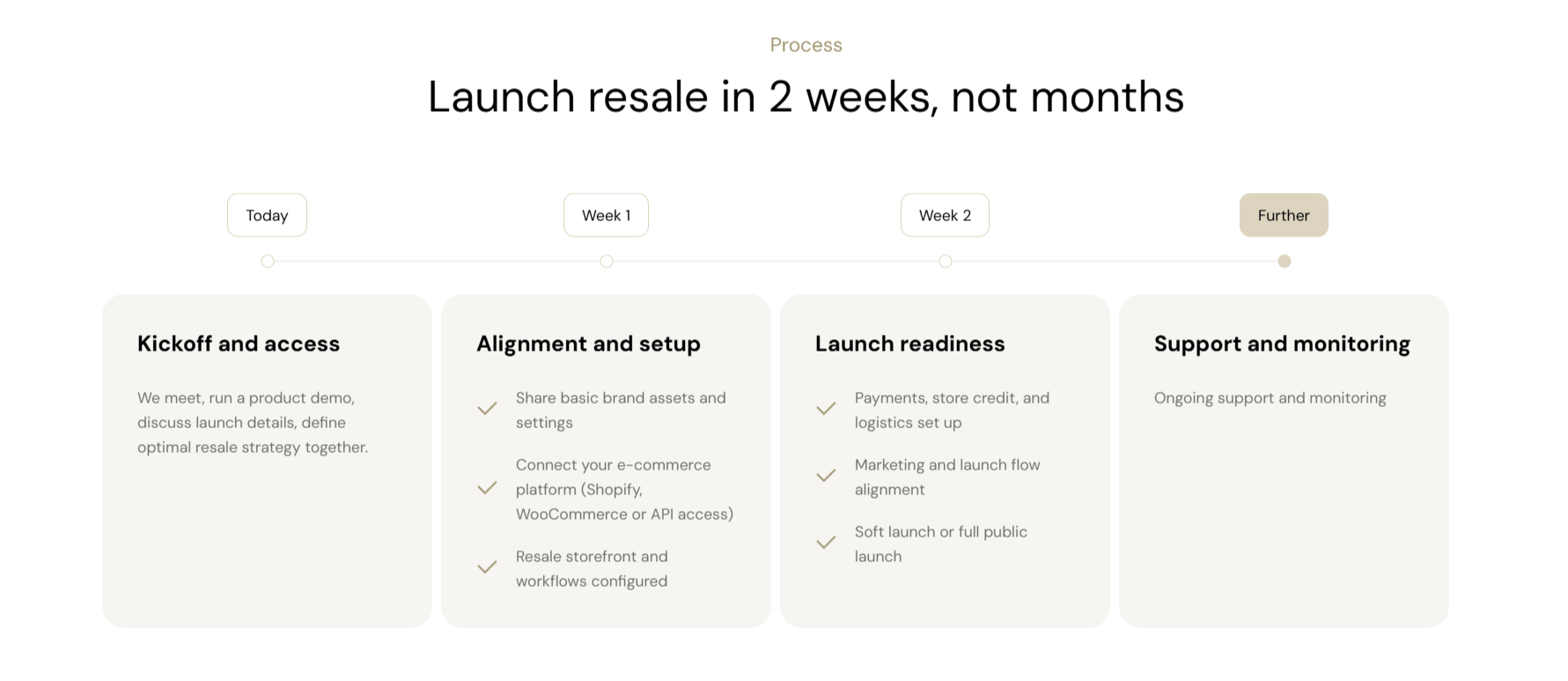
A few technical points: while a brand’s resale marketplace is built and operated by Reloved, data is owned by the brand – and the sellers respectively. Reloved only acts as a data administrator. A brand’s major input is limited to the set-up and customisation process, fully assisted by the Reloved team; everyday operations are automated and managed by Reloved, while physical logistics such as posting and shipping are handled between platform users – sellers and buyers.
From a brand’s perspective, no separate tech or customer service team is required to sustain operations. Brands pay a monthly subscription fee, tailored to their needs, with starting prices in line with popular e-commerce platforms.
In the demonstration, the tool was virtually plugged into a live functioning e-store, and it took literally seconds to create a basic resale platform from the website’s data, ready to be populated by user-generated listings. Reloved is designed to fully synchronise with a brand’s product catalogue; therefore, for each listing, a brand’s database will be used with product information (and sizing). This applies to both items originally purchased on a brand’s website (with the seller’s purchase history available) and items bought either in a physical store, on other second-hand platforms, or received as gifts. A frequent pain point experienced by users – being asked to measure item dimensions – is therefore eliminated.
Similarly, the issue of fakes is eliminated, as this is a brand-owned marketplace. Safety of purchase is also guaranteed for the buyer, with no additional fees besides the item price and shipment.
As ESPR, and particularly Digital Product Passports, are being introduced into the European legislative landscape, a fully integrated resale system will allow brands to stay on top of – if not ahead of – requirements.
“Resale helps us trace the change of ownership; we know exactly when something was purchased. Then, with resale, as I said, we can turn regulatory burdens into new financial opportunities,” says Nurlanov. “It makes the whole legislation story shift from a burden into a new opportunity to recover value.”
He is not alone. In the ThredUp 2026 Report, 66% of retailers report viewing resale as a regulatory solution, 36% as a tool to reduce financial liability and compliance fees in the short term, and 30% as a strategic lever to improve ‘eco-modulation’ in future product design.
The numbers and the origin story
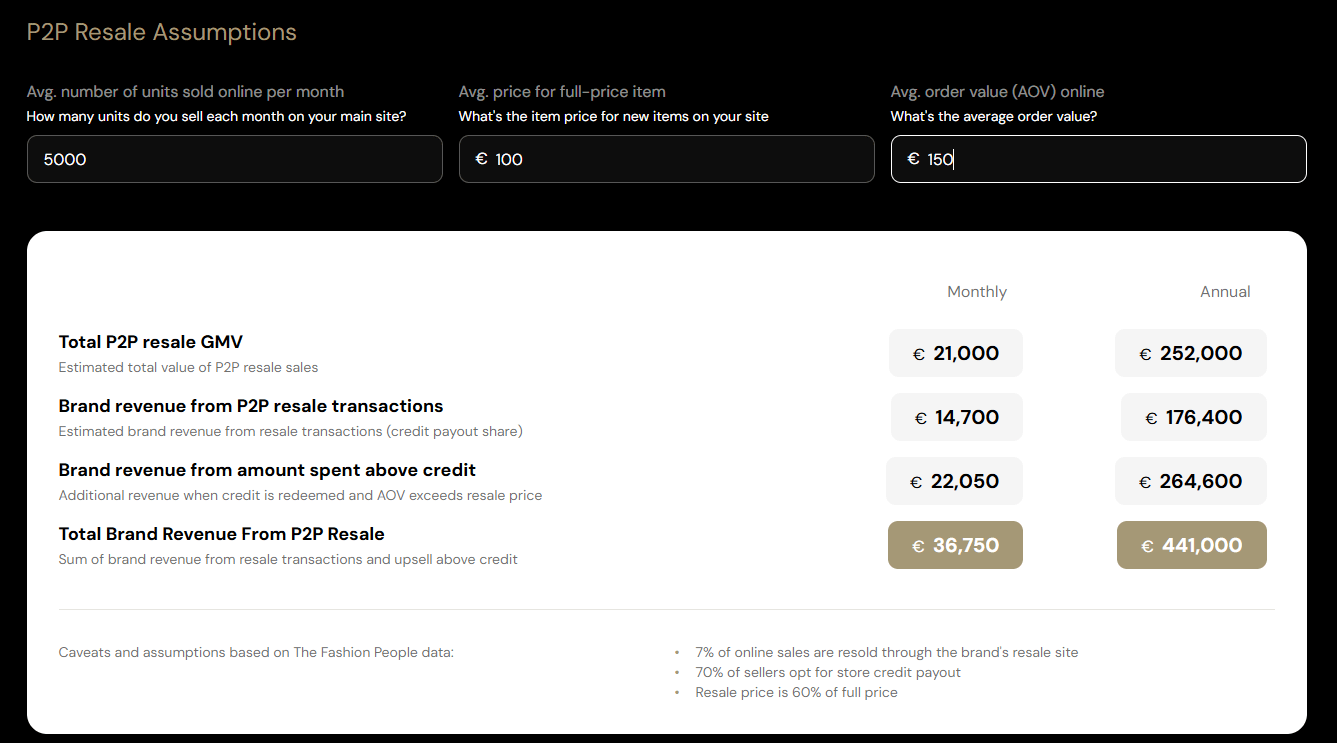
Nurlanov is reasonably enthusiastic. “Resale is the most profitable business in fashion.” Having already used the resources once, items remain in circulation under a brand’s radar. With Reloved, the seller keeps 90% of the sales price, the brand 5%, and Reloved 5%. “As a company, we succeed only once the resale of the brand succeeds, so a brand’s goal becomes our goal.”
The idea of building a business around providing full-package support for other businesses came to Nurlanov, a computer science specialist who graduated from Seattle University in Washington State, while he was trying to sell what he had at home with his family in Kazakhstan. Since OLX was the only available option, Nurlanov set out to establish what would become Kazakhstan’s own Vinted – Garderob.
“I wrote to all sellers I could find on OLX across the country, in different cities, telling them we had launched a new platform that handles all order management for them. We had their existing listings linked back to our site. That’s how we got our first traffic,” says Nurlanov.
He then set his sights on Europe. Last year, the start-up received €5 million in funding to develop, which in itself is quite a nod confirming that this solution has no equivalent on the international market just yet.
Reloved has already collaborated with several brands, such as Bella Freud and Caroline Bosmans. The meeting in Warsaw marked the start of Nurlanov’s tour to London, Amsterdam, and Madrid. Two hundred brands are already scheduled to join the circle in 2026.
According to Nurlanov, brands already using Reloved have seen a fivefold return on investment in the first month. However, it is not the traffic volume of a brand that has grown – it is still the same traffic, but now collected from fragmented places, i.e. resale platforms and beyond. Currently, 46% of resale discovery happens outside resale-specific platforms – via social feeds, creators, and in-person browsing.
The increase in ROI does not only come from the 5% that the brand keeps as revenue. On average, 47% of consumers surveyed in the ThredUp report say they are more likely to make a first-time purchase if trade-in credit is offered, while Reloved’s data reveals that over 70% of sellers so far prefer payout in store credit rather than cash. When spent, those sellers-slash-customers tend to spend on average 250% of the available credit on new items. Thus, once a pre-owned item enters a brand’s resale system, the money follows and multiplies.
The sustainability paradox
This circles back to the question of whether resale is fuelling overconsumption rather than reducing it, as recent Yale University studies have already shown. While it is not the smartest business move for a brand to tell customers to buy less of its products, new or pre-owned alike, what a brand can do for the sake of circularity and degrowth-adjacent goals is consciously (as in: advised by data) reduce the amount of newly produced items. This manoeuvre has now proven financially viable, since potential revenue from new production can be replaced by revenue from resale and, while not exactly an even replacement, there is no new investment involved either.
With items expected to enter resale multiple times, it will also become financially wise for a brand to invest in better quality materials and ethical production to retain customers. Until now, these factors have often been treated as a nice-to-have tick-box or a barely profitable model for a small group of ethical brands.
“This way, a brand’s responsibility continues beyond the point of sale,” says Nurlanov.
The sustainability angle is close to Nurlanov’s agenda, as this was the reason he first reached out to Ewa Polkowska. As a leading expert in clothing production, sustainability and innovative materials, Polkowska was able to gather a like-minded audience.
“It’s a very smart way for us to scale because Sustainable Fashion Institute understands the context – how resale helps from a sustainability point of view, but also supports business goals,” says Nurlanov.
Working closely with the Sustainable Fashion Institute confirmed that there is indeed a gap in the market for exactly what Reloved offers.
“In probably two years, we will definitely notice that brands have got serious about resale and are using these kinds of incentives. Without resale, they can only expand so much, and something new is needed to move further. And resale platforms will definitely keep growing if brands don’t step in,” says Nurlanov.
However, we might not need to wait two years. Right now, 58% of retailers agree that lacking a resale presence creates a permanent structural disadvantage, while 42% identify the biggest risk of not scaling resale as losing Gen Z and Millennial market share – namely the largest share of both luxury and general apparel spending, both now and in the foreseeable future.
- According to ThredUp 2026 Resale Report; all data in this article are drawn from this report unless a different data source is provided (i.e. Reloved, Serve Retail) ↩︎
- According to Serve Retail ↩︎
