
For a collection made from memories of the generational past, Minerva Skyttä has made it feel undoubtedly contemporary, combining her unprecedented knitting technique with sharp cultural observations. Fresh from winning first prize at the European Fashion Award FASH 2025 during Berlin Fashion Week, I caught up with her to talk about what makes fashion meaningful – and, of course, the story behind her multiple award-winning collection.
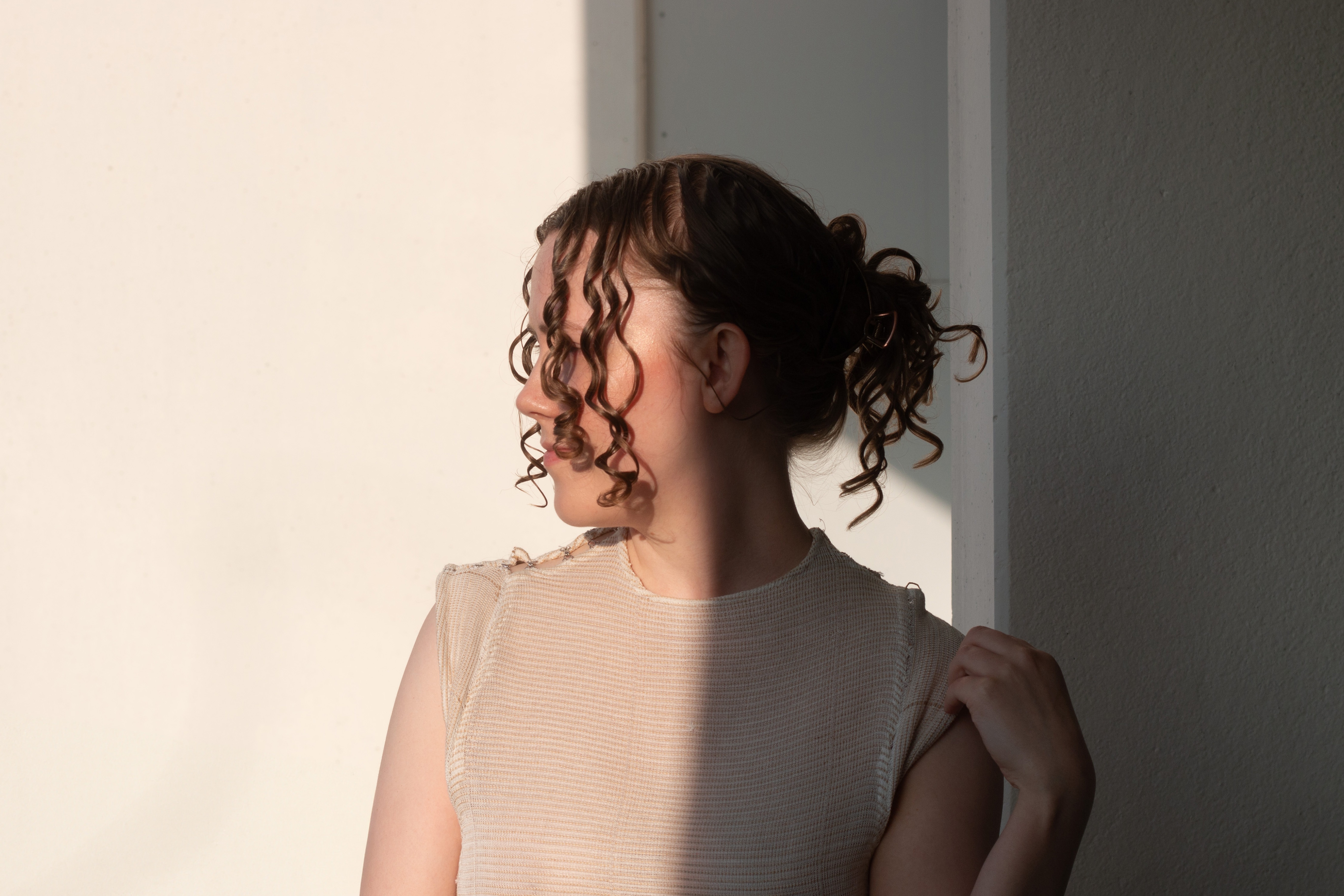

If you could choose one thing to inherit from your ancestors, what would it be? For Minerva Skyttä, it was a suitcase full of letters, which found their way back to her at the moment she needed them most. ‘I burned out before I even started working on my graduate collection. Fashion studies are demanding and intense in every possible way, then came COVID, and back then I simply didn’t see any future in fashion in Finland – no job opportunities, just nothing. I didn’t even feel like going to the show,’ says Minerva.
But ideas and forms eventually emerged from reading all those letters. What started as an intimate endeavour – ‘I didn’t even think I would show it to anyone but myself and my grandmother!’ – became a year-long experiment that led to a collection of six looks. The work not only carried her through graduation at Aalto University of Arts in Helsinki in 2024, but has since won her four further awards, from Berlin to Hong Kong, and counting.
The original family
The story of Minerva’s family – beginning with her great-grandfather, Hannes Sjöblom, Finland’s first missionary to China in the early 1900s, his wife Ellen, their children Paavo and Anna-Liisa, and Anna-Liisa’s friend Annastiina – is one of love and hope, separation and betrayal, woven into the turbulence of early 20th-century history.
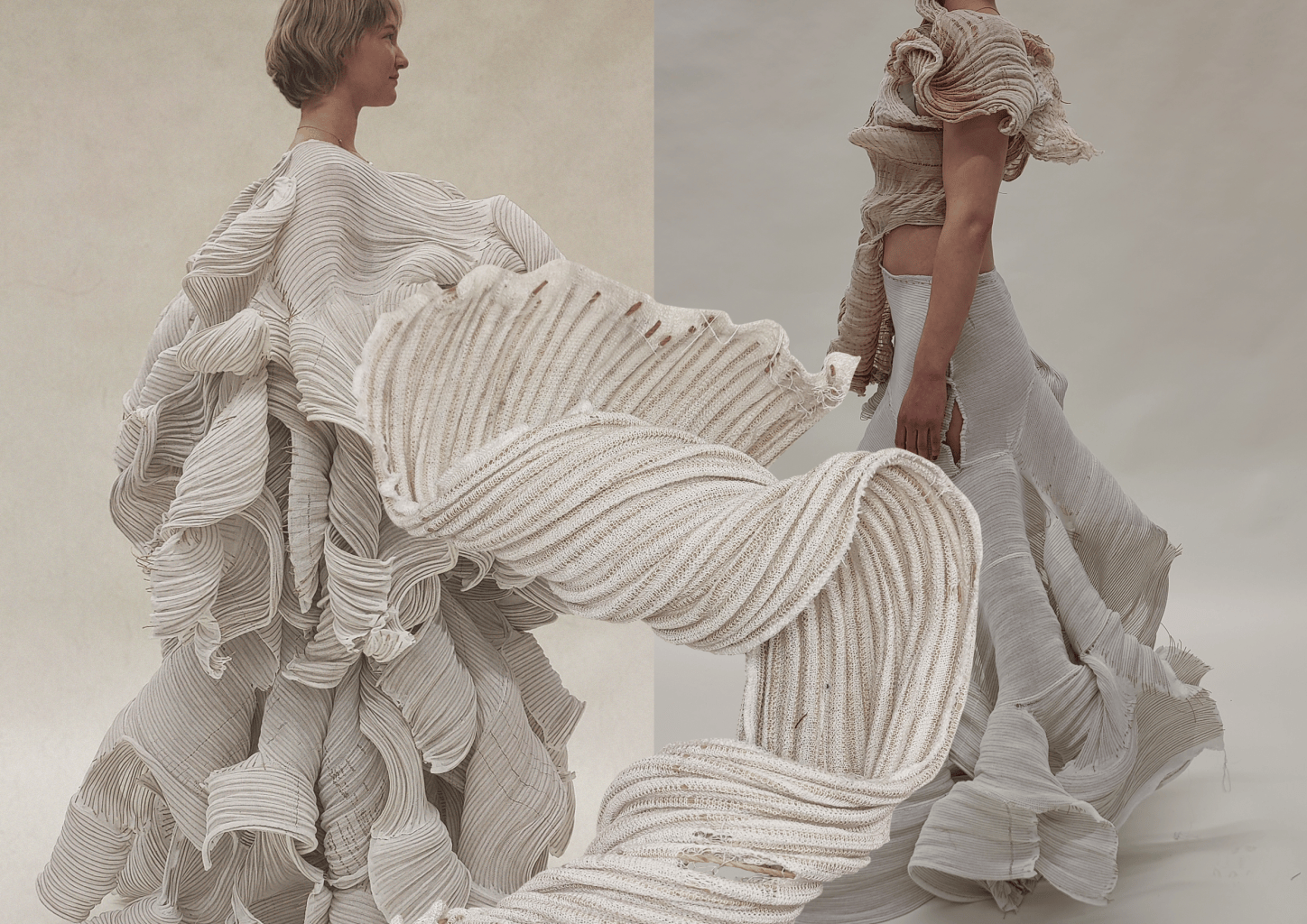
Minerva chose six particular letters and translated them into six pieces. The first look conveys a sense of Hannes’s journeys across America, Japan and, ultimately, China. The second draws on Ellen’s feelings after Hannes left – knits ripped and barely held together. The third is based on a letter about Annastiina’s death, shredded like a fragile memory passed on from one loved one to another. From Paavo’s last letter – he died soon after in the war – came a look bearing the faces of Hannes and Ellen, representing everything he so painfully missed: his parents, his sister, his family as a whole. The fifth look was inspired by ‘the sea and the sun’, described in letters between Anna-Liisa and her daughter about their travels to England.
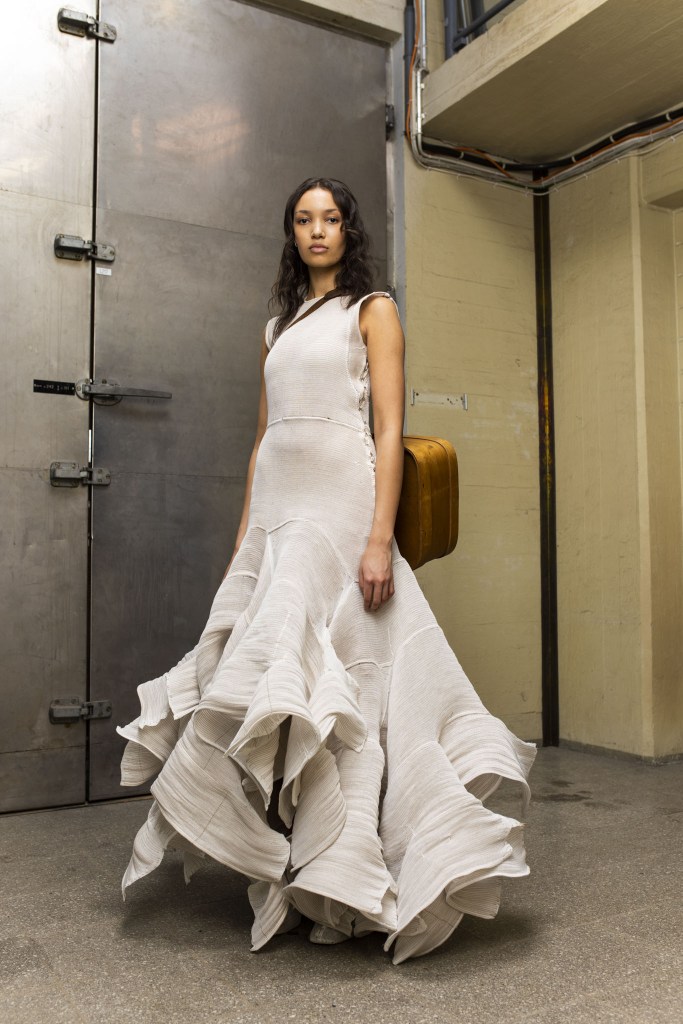


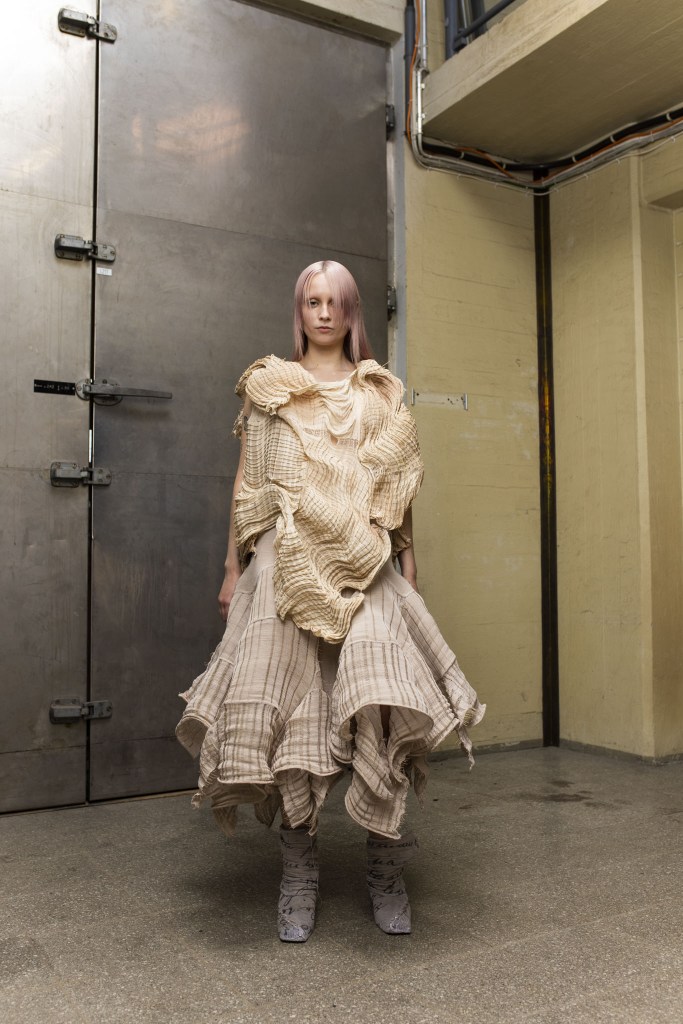

Photo: Sofia Okkonen.
The sixth and final look was inspired by Hannes’s last letter. After running away to China with his mistress and severing contact with his family, he wrote only to his friend Erland Sihvonen, who also served as Finnish missionary to China. Despite his early ambitions, he ended up dying in poverty. ‘I tried to recreate his state of mind, the weight of his own expectations, and the big opportunities he spoke of but ultimately lost after leaving his family,’ says Minerva.
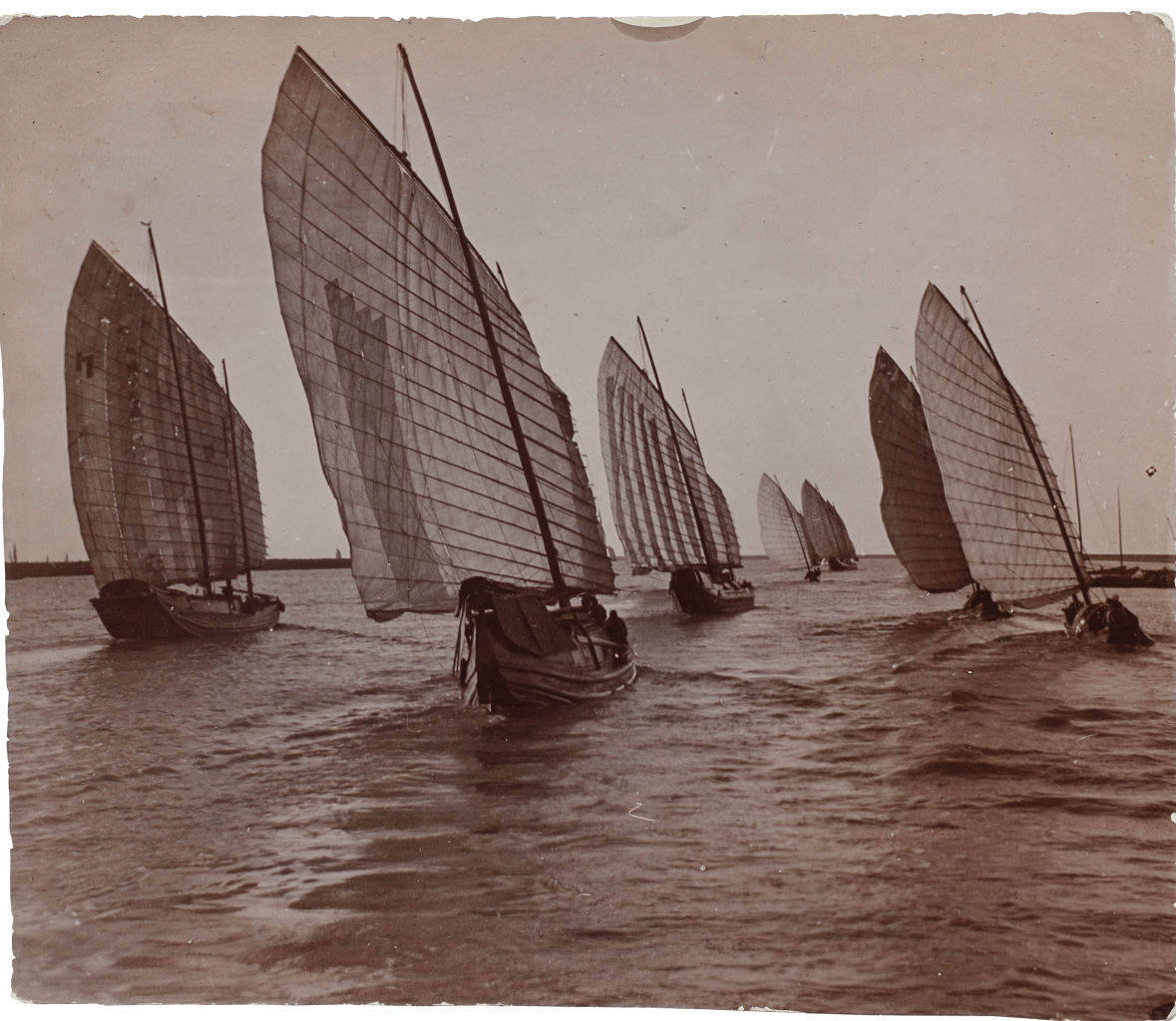
Hannes often enclosed photographs with his letters, and from those showing the sails of Chinese ships came immense waves – heavy with stories and emotions, drifting at sea and at the mercy of the wind. Holes large and small, stains (made with the strongest brew of English breakfast tea), and the very paper and cotton yarn used helped evoke the sensation of the letters themselves in texture, colour and smell.

As nostalgic as the collection may seem, Minerva’s knitting technique is unprecedented. Each look is literally sculpted with an industrial knitting machine, a technique she developed on her own after her professor told her simply to ‘try to feel it’.
Knitting it away
Using around 10 kg of cotton and paper yarn left over from previous projects, Minerva devised an unprecedented workflow with the knitting machine. Instead of removing the material once it was knitted, she lifted it, reversed it, reattached it to the bed, and began knitting over the previous layer, building weight, volume and texture until the yarn was used up.
‘I wanted to do things differently. Before this collection, I made sketches and prototypes, but even the smallest adjustment often meant starting over again. That can be so time-consuming and frustrating!’ says Minerva. ‘Working this new way without relying on endless sketching was very freeing. I could focus on what really interests me – shaping and staying close to the material. And there’s no waste. I think I’ll stick with this way moving forward.’
Minerva works exclusively with natural materials and is deeply conscious of avoiding animal suffering, as well as the challenges involved in verifying whether supply chains are genuinely ethical. ‘It’s especially difficult to research the ethics when supplies pass from one country to another,’ she explains. She sees hope in local sourcing, where production can be witnessed first-hand and regulations provide oversight.


That, for Minerva, is why fashion is ‘inherently political’: one can’t really separate the way people make and buy fashion from political decisions, movements and, ultimately, how the whole system operates. ‘We need stronger regulation – like banning ultra-fast fashion. And I find it shocking that Finnish fur firms still receive government support, with livelihoods defended at the expense of animal lives and suffering. Only politics – or every designer refusing to show fur on the runway – can put a definitive stop to this.’
The recent revival of natural-fur aesthetics worries her, however. ‘Those who wear and showcase fur are giving it free advertising space – when we have no real need for fur accessories at all.’
Minerva prides herself on creating pieces that are difficult, if not impossible, to replicate. While shapes and forms can always serve as ‘active inspiration’ for fast-fashion items, replicating her technique and the unique experiential quality of her work would be straightforwardly unprofitable.
‘I would love to continue with couture – the craftsmanship, the unusual and unique pieces. I want to change the way consumers think and let them know that what they are dealing with is truly one-of-a-kind.’
A simple story, and double lenses
Minerva sees fashion as a form of art – a visual expression holding emotions and personal experiences, while reflecting culture and society. ‘This is why it moves between art and everyday life. I like to see clothing in a similar way to architecture, where functionality doesn’t cancel out the artistic dimension. Clothes can be appreciated for their aesthetics and for the stories they communicate. The most powerful collections carry a meaningful story that resonates with people.’
A fashion graduate and now a political science student – a second degree she began during her burnout, inspired by the engagement and energy of her peers – Minerva sees fashion through both the lens of an artist-creator and that of a social researcher. ‘My creative process always begins with research and collecting materials, and it always involves people for inspiration. I like to immerse myself deeply in a topic. Since I’ve always been interested in politics, I took a year off and started political science. It gave me a new perspective on life and on the connections between fashion and other fields – a chance to go deeper into academic thinking.’
Interestingly, Minerva’s introduction to fashion wasn’t a childhood prodigy story. It came later, when she was old enough to recognise her strengths (‘I’ve always been good with crafts’) and open to experimenting with whatever sparked her interest. At 19 she moved to Helsinki, where her then-boyfriend introduced her to the world of fashion shows. ‘I was deeply impressed and knew I wanted to do something like that myself. The beauty of clothes in motion on the body did it for me.’

Photo: Kristian Presnal

Photo: Johanna Rontu
For Minerva, the simplest and greatest joy of fashion is the creative process itself: ‘I believe it has a value of its own – it just needs to be done the right way.’ Not concerned with chasing particular names, she focuses instead on interactions, travelling and exchanging ideas with other fashion professionals. Recent opportunities have included awards ceremonies in Hong Kong and, most recently, FASH 2025 in Berlin, where we met.
For Minerva, meeting people, seeing what others are creating, and working closely with models and photographers is the most valuable prize – above cash awards and press recognition, though these are, of course, very warmly welcomed too. ‘It’s also very nice to see my clothes on new models, and to experience first-hand how different people react to them.’
Grateful for every award, review and photograph (‘FASH also gave me great photos!’), Minerva remains focused on developing her own language of clothing while staying open to whatever opportunities life brings. ‘I wish for my own fashion brand, and to establish myself as a Finnish couture designer,’ she says with sparks in her eyes. For now, she is preparing for a series of exhibitions and fashion shows, and we are keeping our fingers firmly crossed to see more of her creations in the future.
Awards
- European Fashion Award FASH 2025 – 1st prize (2025)
- Culture X AI 2024–2025: Culture and Future Mode by Laboratory for Artificial Intelligence in Design (2025)
- Global Creative Graduate Showcase 2024 award for Formal/Couture in collaboration with WGSN + Coloro and Google Arts & Culture (2024)
- Näytös24: The City of Espoo Award (2024)
Discover more from Vegan Fashion Repository
Subscribe to get the latest posts sent to your email.