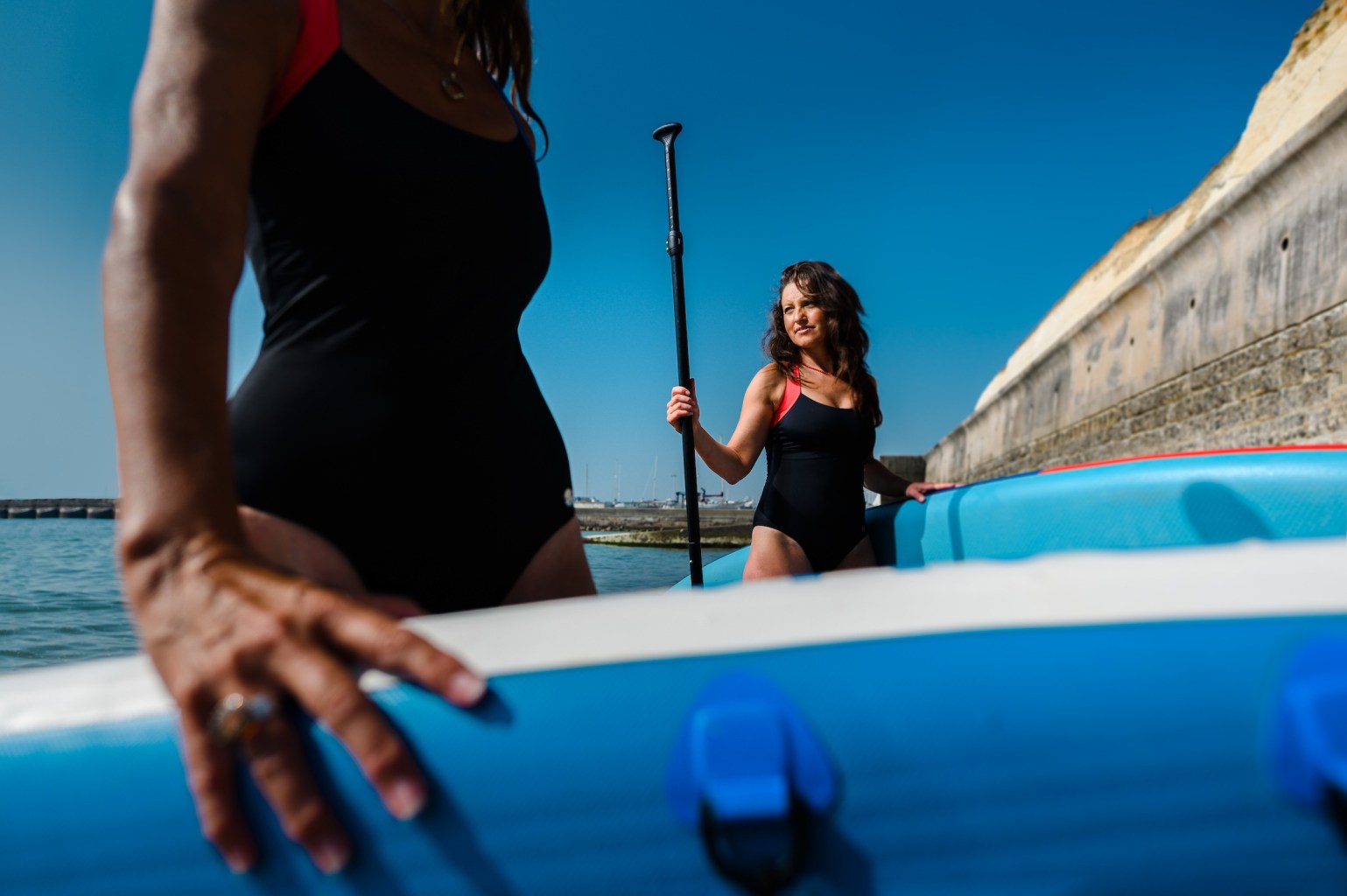
Founded in 2010, RubyMoon was the first European brand to use Econyl made from discarded fishing nets and other nylon waste. Sixteen years later, the company is developing the world’s first fully recyclable swimsuit. Founder and CEO Jo-Anne Godden speaks about building a circular system — both environmental and social — piece by piece.
Let’s start at the very beginning. In 2008, Godden was travelling from the US back to the UK for a job that was rescinded while she was still on a plane. The global financial crisis had begun to take hold. “They said people would never buy anything again. It was really quite dramatic,” recalls Godden. With a successful corporate career in swimwear and lingerie that spans both design and production management, and a lot of time on her hands to think about what she really wanted to do next, she picked up two books that would set the course: Lucy Siegle’s To Die For. Is Fashion Wearing Out the World? and Nicholas Kristof and Sheryl WuDunn’s Half the Sky.
“They do say if you’re going to start a business, do something around a subject you know. I decided to use the skillset I already had and develop a business that had positive impact, rather than just degrading people and the planet.”
The name came from Ruby – in honour Godden’s grandmother, who taught her to sew – and from the giant moon Godden saw one night in Bali, hovering over its reflection in the water. And the rest is history.
Real problem, clickbait drama
Back then, awareness of ocean waste was still nascent. “I spent a lot of time explaining why this is important because people didn’t know what we were doing to our oceans, or about the pollution associated with fashion and plastics.” Environmental organisations were speaking out, too. It wasn’t, however, until David Attenborough’s Blue Planet II (2017) that the issue finally reached the mainstream. “People don’t take notice until someone like him talks about it,” says Godden.
Since then, it has become significantly easier to communicate about cleaning beaches, reducing plastic use, and recycling ocean waste. More brands have followed RubyMoon‘s footsteps as well.
“Younger people getting more involved, thankfully!”
However, for customers, it has become only trickier to filter through the noise. “I would have said it had become easier a couple of years ago, but now there’s so much misinformation coming not just from brands but unfortunately from ill-informed influencers and activists and their broad-brush clickbait statements.”


Take the December 2025 Spinning Greenwash: How the fashion industry’s shift to recycled polyester is worsening microplastic pollution report by the Changing Markets Foundation. The report quickly sparked strong reactions on social media, with some commentators questioning the entire concept of recycling synthetic fibres. The real issues, however, are far more complex: the industry’s reliance on synthetic fibres due to overproduction and overconsumption, persistent policy gaps, and the prevailing practice of picking false solutions. Bottle-to-fibre recycling, for example, breaks the circular loop by converting PET bottles into textile fibres — a lower-quality material that is rarely recycled again (an open-loop system). By contrast, recycling bottles back into bottles preserves material quality and allows the cycle to continue many more times within a closed loop1.
The report itself is based on a sample of just 51 garments from selected brands and thus, while indicative, the authors note that a more comprehensive assessment would be needed to evaluate impacts across the full scale of global production.
“It kind of upsets me that all these fashion activists on Instagram pick up on these things but don’t actually go and read the report,” says Godden. “I actually want to know the details before I spend like twenty minutes producing seven-screen Instagram posts about something that I haven’t fully understood.” She believes that it is our accustomed reliance on short bits of information — to our detriment — that actually allows people to post things they haven’t properly checked or researched first. “That’s quite unethical, I think.”
Getting circularity right
Among the many sustainability and degrowth goals, durability and recyclability have emerged as key principles, though not without controversy as synthetics are involved. Natural fibres, however, are no solution. As stated in the same report, cotton, viscose and wool shed similar or even greater amounts of fibre, polluting coastal seawater along the Kenyan and Tanzanian coasts.
“All textiles have their impact on our environment, and all garments require resources, whether that’s water, pesticides, land use or transport,” says Godden. “The trend to promote so-called natural fabrics over synthetics is totally misguided.”
Take cotton, for example, which is an extremely water-intensive crop and a fibre that wears down quickly unless blended with synthetics. “If you’re a parent, you have to buy school uniforms with polyester content; otherwise, they last five minutes.” Buying new garments frequently means repeating the entire chain of resource use, while synthetic fibres, by contrast, last longer and can be worn many more times.


For Godden, the key parameter is the number of wears per garment. “What circularity in fashion is all about is buying less but better quality, for the right purpose, and making it last. You never buy anything you’re not going to wear 50 or 100 times.” Designers therefore need to focus on creating beautiful garments and choosing the best textile for a garment’s purpose. Once a garment has served its purpose, it should be recycled so that its resources can be recovered. That’s circularity.
“We never put garments back into the soil,” says Godden. The used – or sometimes unused – garments usually end up in landfill, and either stay or are moved elsewhere, or are incinerated – all of which can release harmful substances into the environment. For Godden, making a garment fully recyclable, not biodegradable, is the holy grail.
“All textiles have their impact on our environment, and all garments require resources, whether that’s water, pesticides, land use or transport. The trend to promote so-called natural fabrics over synthetics is totally misguided.”
Jo-Anne Godden, Founder & CEO or RubyMoon
The world’s first fully recyclable swimsuit
In the past three years alone, textile recycling has evolved from downcycling to developing technologies such as depolymerisation, enzymatic recycling, and AI-powered sorting systems that can now deal with blended textiles and prevent quality loss with each recycling cycle.
RubyMoon is adding to the mix, having patented a chemical-free process to reclaim nylon from blends with elastomer, thus making fully recyclable swimsuits a reality. The swimsuit does not need to be disassembled before it enters the process. ‘We are closing the loop on our materials. When a garment is no longer wearable, all those resources will be reclaimed,” says Godden.
It took five years of collaboration between RubyMoon, the University of Leeds (UK) and the Eurecat Technology Centre (Spain) to develop the right process, and RubyMoon is now crowdfunding the final phase of the R&D, during which the swimsuits will be produced. The swimsuit is designed by Godden herself, and crowdfunders can purchase one as a token of their support.
If successful, RubyMoon will extend the technology to activewear and build a pilot plant to collaborate with large brands to spread the impact.
“That’s my personal agenda for the next 10–20 years. We have to actually start making a change to stop that landfill situation.”
Better choices
Stopping the ‘landfill situation’ requires tangible degrowth measures. Global fashion production currently stands at somewhere between 100 and 150 billion garments per year (Fashion United), of which approximately 92 million tonnes end up as textile waste (UNEP). These figures are estimated to increase to 200.8 billion garments and 134 million tonnes of waste by 2030, respectively (Statista, Business Waste). For brands like RubyMoon, promoting degrowth while introducing products to the market requires full transparency and accountability in their circular business models.


“We are replacing a pair of leggings that one might buy from fast fashion with something better, more durable, made from recycled materials, and with lower environmental and social impact,” says Godden. She also stresses the importance of aesthetic value in creating emotional attachment, “so that people won’t just throw them away or push them to the back of their wardrobe.”
RubyMoon’s signature ‘Gym to Swim’ capsule collection embodies this philosophy by allowing garments to serve multiple purposes — from activewear to swimwear, and even casual everyday wear. Extending a garment’s function reduces the number of items consumers need to buy. Once the need is covered, what remains are habits. “We can be activists against those companies, or we can be activists in what we do every day. Or both, if there’s time, energy and budget for it” says Godden. Reducing environmental and social impact, according to Godden, is everybody’s resposibility regardless of one’s line of work.
“I think it’s more a matter of time constraint, especially when we’ve become accustomed to this environment of covennience. And that’s what fast fashion is about,” says Godden.
RubyMoon’s garments are produced either in the UK or in Spain, with Econyl sourced from local ocean waste. “We have to think of our business as a holistic impact cycle rather than separate impacts”. Having a local supply chain allows RubyMoon to reduce carbon emissions by up to 42%, ensure safe working conditions, and eliminate risks of modern slavery, strengthening sustainability claims in accordance to evolving European legislation.
“If people are going to spend time being activists, I think it’s really important that we tell governments to create legislation that everyone must follow. We don’t have these choices anymore – we’re past the sell-by-date on environmental pollution, animal testing and mistreatment, and are making the planet uninhabitable.”
“We have to think of our business as a holistic impact cycle rather than separate impacts.”
Women power

RubyMoon’s impact extends beyond oceans, animals and supply chains. Just as the brand has systematically worked to close the recycling loop with garments and materials, the same philosophy applies to social impact. As a community interest company (CIC), the brand donates 100% of its profit to microloans for women entrepreneurs around the world. Once repaid, the loans return to the pool to support others. Godden has already supported over 2,000 women in 14 developing countries, and still counting.
“That’s really what our holistic circular approach and circle of impact is about,” says Godden.
The microloans are distributed through Lend with Care, a London-based organisation that allows donations from as little as £15 to support individual or group entrepreneurs. Lend with Care also provides educational support to help participants develop their businesses. “When people are on the edge of poverty, it’s really important that the help is done properly. If you don’t help them build a business, you are actually making their problem worse,” says Godden.
Godden makes it her mission to support women.“It’s been proven that when women have an independent income, they spend it on things that make a real difference in the lives of their community and families, such as good nutrition, schooling for their children, and decent housing,” she says. “It is also often the first time they have a voice and for people to take notice of these women. Income means they become empowered in their community.”
One woman in the Philippines noticed reeds growing wildly around her home and garden, and began weaving them info baskets. With a microloan from Godden, she expanded her business and now employs twelve other women. “Of course, if I see a woman starting a sewing business, I tend to be a little bit biassed”, Godden laughs.
With around 80% of the 75 million people in the global fashion industry being women, every act of support can make a tangible difference.
Perhaps it is not through doomsaying, guilt, or targeted messaging, but through helping people understand that everyhing – and everyone – is connected that circular fashion models will truly take root.
For the last 16 years, customers have asked Godden questions about virtually everything. Some were concerned about the environment, some about the locality of supply chains, some even about fishing nets — with no issue emerging as major or leading.
“Running RubyMoon has educated me that everybody is so different, and everybody is motivated by many different things. The ethical customer cares about most issues; there’s just a different degree of passion for each. But it’s all connected.”
All images courtesy of RubyMoon
Author

Discover more from Vegan Fashion Repository
Subscribe to get the latest posts sent to your email.