

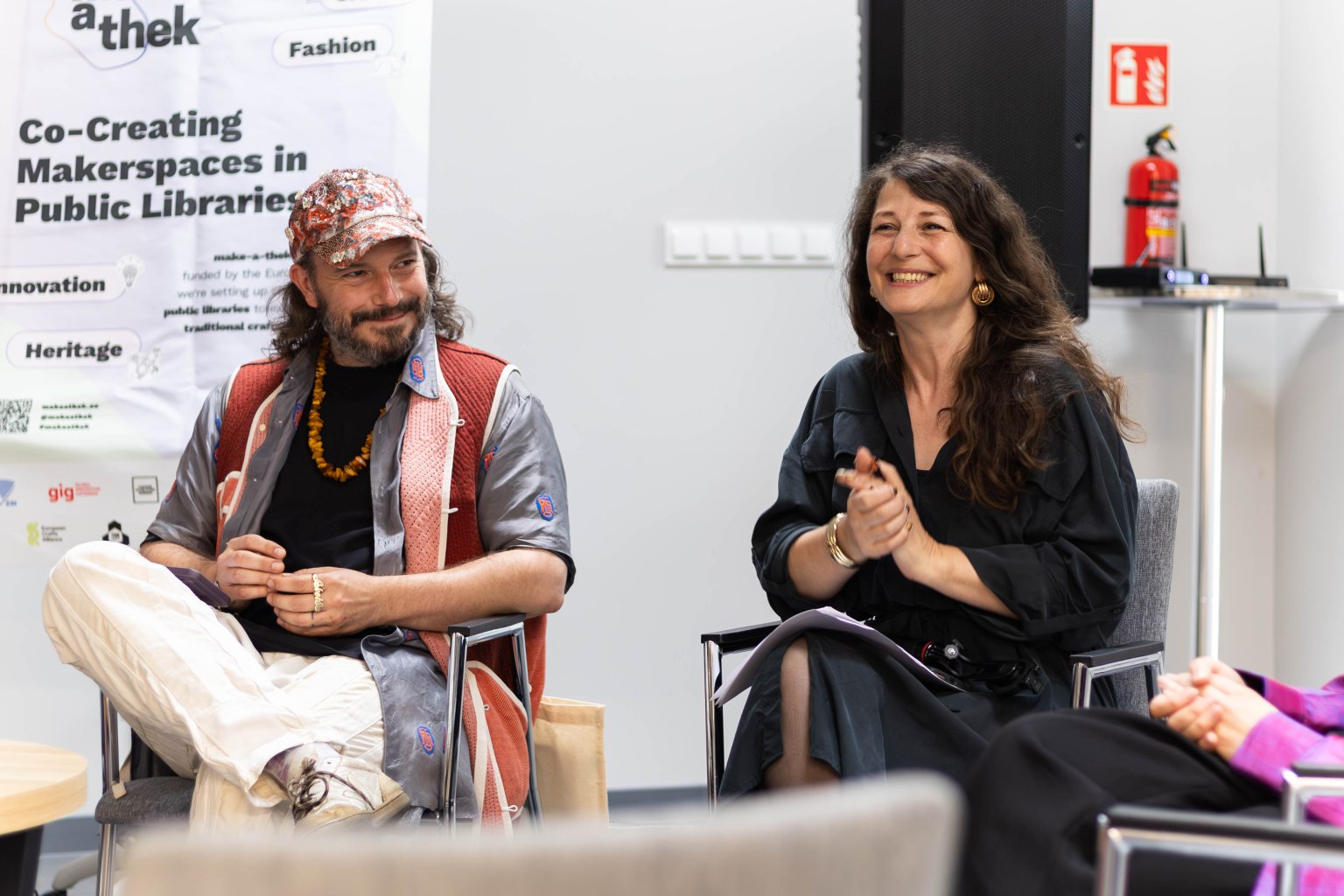
What if libraries weren’t only for books, and circular fashion wasn’t a far-fetched slogan made up by industry specialists but rather a way local communities live by? In an unprecedented brainstorm session hosted by the City Hall of Łódź with Make-A-Thek, industry professionals and local residents came together to share their perspectives on overconsumption and circular fashion.
Matty, a mobile workshop bus equipped with tools, machines and repair kits, is currently travelling across Europe hosting hands-on circular fashion and craft activities, as well as collaborative events. The project is part of Make-A-Thek, an EU-funded initiative aimed at building a European network of public libraries with integrated makerspaces—community-operated workspaces where people can repair and upcycle clothes—starting with 10 pilot libraries in 2026. The project is the brainchild of Geraldine de Bastion, founder of Global Innovation Gathering and a political scientist, and Max Gilgenmann, a leading voice in sustainable fashion, co-founder of Studio MM04 and co-chair of Fashion Revolution Germany. The project was co-created by Global Innovation Gathering and Fashion Revolution Germany together with seven other European partner organisations: Fab Lab Barcelona/IAAC, the European Crafts Alliance, Fab City, Open Dot, the Ukraine Maker Association, Public Libraries 2030 and ZSI.
In Poland, the project made a special stop in Łódź—a city built on a rich textile manufacturing heritage dating back to the nineteenth century and now reimagining that legacy for a new era. Together with the City Hall of Łódź, the team organised a gathering titled ‘A Climate of Overconsumption’. Participating on behalf of the municipality were Dr Anna Wierzbicka, Director of the Ecology and Climate Department at the City Hall of Łódź, and Magdalena Martin-Walczak, project manager in the Environmental Management Unit in this department.
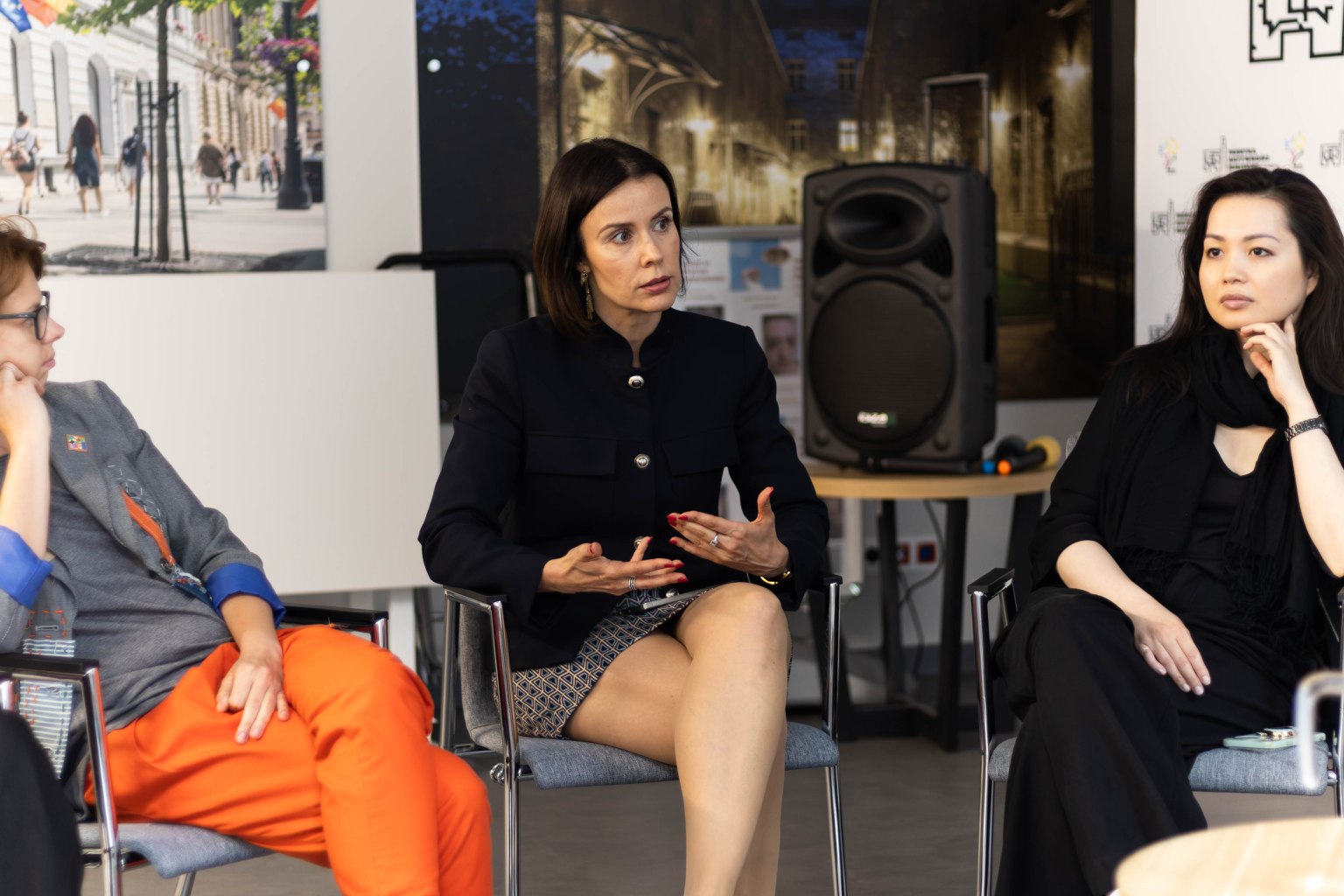
Alongside Geraldine de Bastion, who moderated the discussion, and Max Gilgenmann, the panel featured Dr Michał Szulc, fashion designer and former Director of the Fashion Department at the Academy of Fine Arts in Łódź (2020–2024), Sonia Veselska, fashion designer and student at the Academy of Fine Arts in Łódź, Boyant Kuroku and Macieya Budka, arts and crafts workshop leaders, and yours truly. Last but not least, residents of Łódź joined the conversation to share their perspectives and ideas on how they would like to engage with fashion, and circular fashion in particular.
Upcycling and the wording problem
In an attempt to fight overconsumption, upcycling typically pops up as a solution, as in having people upcycle or buy upcycled products made from materials which require no new resources to be made except for human and design work. As promising as it sounds, upcycling faces a major perception problem. ‘People only think this is made of rubbish and laugh at us,’ says Wierzbicka.
The struggle to find another word for ‘upcycling’ is shared by both Global Innovation Gathering and Fashion Revolution Germany. ‘We want to destigmatise it,’ says de Bastion.
‘Upcycling is the most creative element in fashion. People should love it and explore it, not laugh at it,’ says Gilgenmann. He is far from alone. In recent years, psychologists and authors such as Patricia D. Stokes, Barry Schwartz and David Epstein have argued that when the brain is forced to work within limitations—whether objective or self-imposed—instead of relying on readily available solutions, breakthrough ideas often flourish.
For many designers, including students like Veselska, upcycling is a priceless lesson both in creativity and resilience – in a literal way. ‘Not having to buy new materials and reusing the materials we already have access to, and thinking about ways to incorporate these materials even if they happen to be less than ideal, makes us think more about how to actually use them – and that truly boosts creativity.’
The key goal of having Matty travelling across Europe is to work with both libraries that already have makerspaces, as well as helping those that do not have one to establish one. ‘Libraries are places for knowledge, and fashion is a kind of language. We wanted to see what places give people more access to that kind of information, and allow people to learn new skills,’ says de Bastion, and adds: ‘You could really see the social function that these makerspaces are serving. That’s what we’ve seen on this trip. We have to have those places where people come together and discover things that connect us, and places that cost no money – usually coffee shops or clubs cost money. But a library costs no money to get into.’
The scale of overconsumption
With one truck of clothes being dumped into landfill every single second1, getting people together to upcycle, or simply sew and mend things is one thing. But how do we grassroot a fight against overconsumption?
To start with, overconsumption is by no means just a contemporary phenomenon. People have been overconsuming since the moment they stopped buying what they need and instead started buying what they want, simultaneously enabling and falling prey to the economy of looking and being judged by appearance through mass-produced fashion items, a system which began roughly 150 years ago. Thus, asking people to ‘stop overconsuming’ is essentially asking them to unlearn patterns that have been deeply and systemically ingrained over generations in capitalist societies.


‘One of the key solutions to fight overconsumption is the question of pricing – who is willing to pay what for what. It’s a question of value and accessibility. Overconsumption happens when there’s opportunity. We have created some industries where overconsumption is so easy and cheap,’ says Gilgenmann.
Poland, which only re-joined the capitalist circle after 1989, caught up far more smoothly than many imagined. ‘We [the generation that grew up during or before the 1990s] remember what was good and what was not good. We felt the quality if we touched the fabric. What’s ironic is that we knew it when we had nothing, and that’s why it was very important to have good things that would stay with us for a long time. The newer generation didn’t have the chance to experience this.,’ says Szulc.
Sadly, even that haptic memory stands no chance against the fast-fashion and ultra-fast-fashion machine of the last two decades.
Gilgenmann agrees. ‘Before we are consumers, we are citizens first. We have to have a better understanding of quality; otherwise we cannot judge well.’
But is ‘educating consumers’, as so many brands and advocates promote, effective enough? Views remain sharply divided. Małgorzata, one of the local representatives who joined the gathering, doesn’t believe in it at all.
‘Education only works for some people, but if government doesn’t change things, nothing changes. Only law can change the way we act, behave and buy,’ she says.
‘Education can work or not – it depends on the situation and who is doing the educating; what kind of mind you have at the moment. Nowadays there’s so much information and everything wants to educate us – even information about where to buy cheaper is also education. Life has become more complex in the last 20 years,’ says Gilgenmann.
Szulc agrees. ‘It works only when a person wants to be educated.’
Luckily, some remain firm believers. ‘I do feel better about myself when I do something, or at least try to do something [about it],’ says Martin-Walczak.
And do something she does indeed. Martin-Walczak is the one who came up with ‘fair fashion’ as a set of words to communicate fashion that is slow, upcycled, or simply made responsibly, as opposed to ‘fast fashion’. The phrase has now become a commonly used expression during and beyond the ‘Trend Station’ – the annual flagship event in Łódź promoting responsible and innovative fashion that Wierzbicka and Martin-Walczak are key forces behind.
‘I had CEOs and CFOs saying: “This is shocking. I have to think about it. I have to change it,”’ says Wierzbicka, adding: ‘I had at least ten people say this to me, and even if it’s just them, I believe this is how it works.’

The way forward
Until we make the new paradigm of buying less the new cool, no one will really buy into it – pun intended. And for that, buying second-hand is hardly a fix-all; instead, it can be a significant driver of overconsumption, as the frequently quoted Yale study published in December 2025 suggests2.
‘We need to look into ways to have people consume differently – otherwise we run the risk of shifting people into “I need something new” instead of helping them find love in something they already own,’ says de Bastion.
So what’s at the core of the problem?
Despite all the creativity and glamour, fashion is business, after all, and one built on continuous aggressive growth which feeds on – and therefore curates – a multi-billion-dollar marketing machine dedicated to telling people to buy more. This is why, amidst today’s anxiety-driven zeitgeist, fast fashion, and particularly ultra-fast fashion, has swept in so efficiently.
‘Ultra-fast fashion has discovered and explored the gaps of the Western fashion system, mastered short production runs, used AI-based solutions and become much more efficient. The Western fashion system hasn’t invested in efficiency in the last 30 years – only in making things cheaper, including labour costs,’ says Gilgenmann.
‘When I found myself negotiating the price of a button, I told myself something was going in the wrong direction,’ said Szulc, sharing his journey from being a cog in the system to becoming someone actively leading the way towards change.
‘As students, we all went into fashion because we love it, and once you’ve seen the backstage, you really have to learn to love it again,’ says Veselska.

But in Gilgenmann’s words, as we reach the very bottom of the spiral of cheapness, there is only one direction left to go.
As a matter of fact, some major brands are already making promising investments. Kering has pledged to increase the use of alternative and bio-based materials to approximately 40% of its portfolio by 2035, alongside a 30% reduction in leather usage by 20283. Miu Miu has been releasing upcycled collections since 2020. It is particularly important for luxury brands to lead the way as, like it or not, these are the ones that set the example simply because people look up to them, whether they can afford them or not.
In Poland, mainstram fashion brand Tatuum now offers a 10-year guarantee on its products, aligning with the newest ESPR requirements in Europe.
‘Having big companies taking part in this makes me optimistic,’ says Wierzbicka. ‘If each producer could create a collection and give it even just five years of quality and say, “If that’s not okay, give it back to us”, and then upcycle it instead of throwing it away, business would still work.’
As humanity is currently using nature 1.7 times faster than Earth’s ecosystems can regenerate4, and sustainable fashion has largely fallen short of making these issues a common interest, only collective action across all stakeholders — including designers and customers — alongside technological development and supportive legislation — can lead to meaningful change.
‘There have to be a lot of people speaking in different ways but working in the same direction,’ says Szulc.
For each and every one of us, let’s start by mending things instead of buying new.
And that’s what Matty is here for.
All photos by Weronika Sztobryn
Footnotes/further reading:
- https://earth.org/statistics-about-fast-fashion-waste/ ↩︎
- https://news.yale.edu/2025/12/08/second-thoughts-secondhand-why-resale-market-expanding-fashions-carbon-footprint ↩︎
- https://www.kering.com/en/group/discover-kering/our-strategy/ ↩︎
- https://www.footprintnetwork.org/2024/07/21/earth_overshoot_day_2024/ ↩︎
Author

Discover more from Vegan Fashion Repository
Subscribe to get the latest posts sent to your email.