

They call her a futurist – although the term requires a broader definition in her case. Marlena Woolford, one of the four founders of FUTUREMODE: European Fashion Innovation Hub, talked me through the latest developments in AI, forecasting, and innovation – and, finally, her “quantum mind”.
AI is reshaping the way humans produce, use, and perceive fashion, much as photography redefined art at the turn of the twentieth century. “Initially, most artists focused on painting realistically, but once photography emerged, that was no longer their primary focus. The invention of photography did not kill art, but paved the way for new forms of innovation, experimentation, and the emergence of varied art styles such as Impressionism, Abstract Art, Surrealism, and other movements. Photography, in effect, raised art to new levels,” says Woolford.
To illustrate her point, Woolford tells me about an experiment she conducted some time ago. “I asked AI to create a pool table, and it created one with balls floating above it, defying the rules of gravity. That’s AI hallucinating for you.” says Woolford. “With AI, it’s always about probability – 100 per cent accuracy is not very likely. Even if you get it 97 per cent right, there is always that remaining 3 per cent where it can be wrong. That’s why everyone tells you to double-check AI results, because some of what it produces won’t be true – it will be created by AI itself.”
“From a creative perspective, however, this also presents an exciting opportunity. AI hallucinations can spark ideas that no one has thought of before. They’re random, unexpected, unusual, different – and for inspiration, these ‘errors’ can actually become a source of additional ideas,” says Woolford and lists the most significant areas in which AI is already improving fashion production – from reducing waste in prototyping, pattern cutting and manufacturing, to enabling the self-production of visuals and videos for marketing, writing press releases, and calculating and optimising pricing.
“AI handles all the boring tasks you don’t want to do, much faster than you can, so you can focus on your brand, your creativity, and your ideas.”
The Case of AI


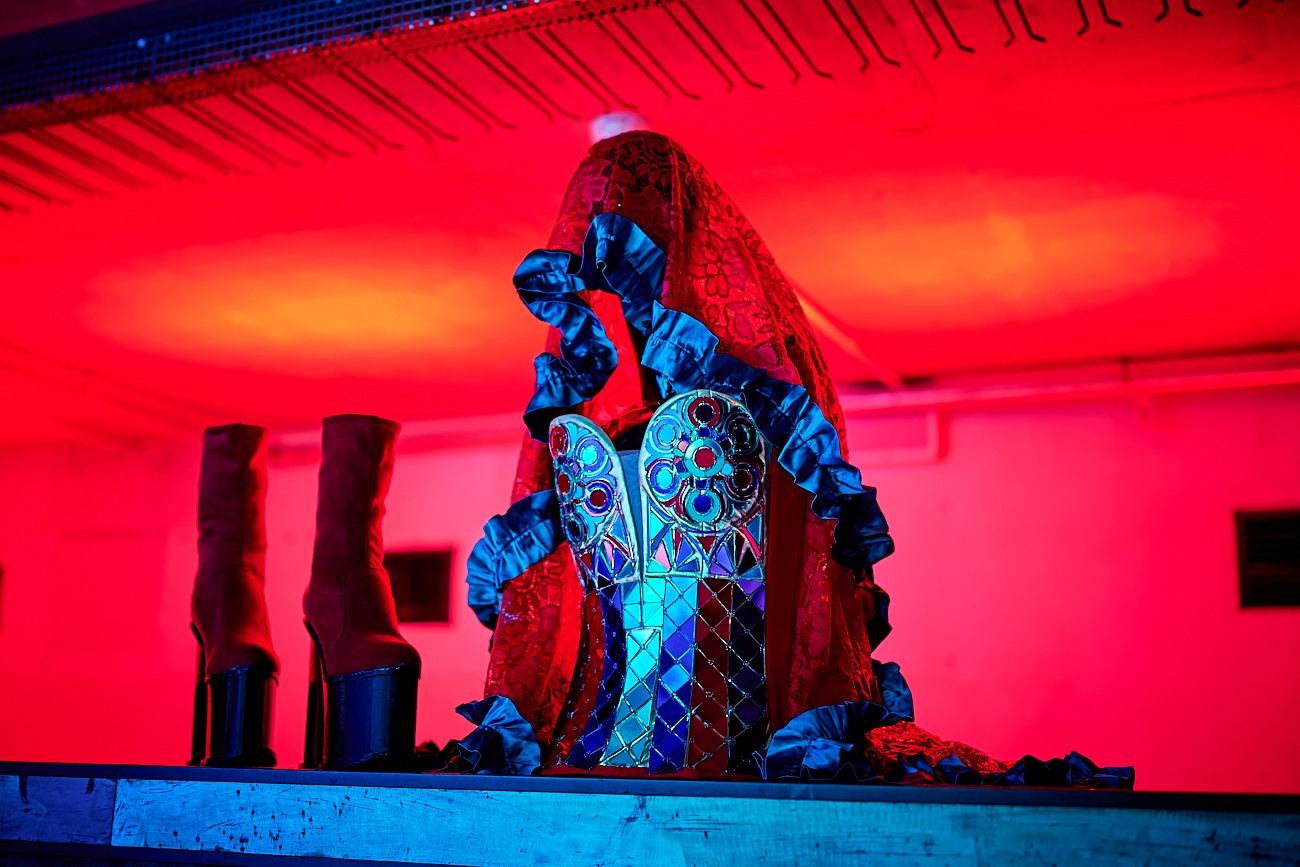
In creative endeavours, however, AI should be used as a supporting tool rather than a replacement for human input. “AI can help us become more creative if we don’t treat it as a technology that does things instead of us, but as a tool that supports us. If people decide, ‘OK, AI is going to do everything for me’, then that’s one approach. But if someone says, ‘I’m still a designer – I’m going to use my skills, my abilities, my humanity, my brain, my knowledge, even manual research, travelling, observing – and on top of that, I’ll use AI’, then you have something much more creative.”
With so much noise surrounding the ‘human versus machine’ debate, and with generative AI increasingly learning to imitate human input – for better or worse – it is both uncanny and exciting to realise that, by studying how AI works, we also gain deeper insight into our own conditioning. Woolford recalls attending a lecture at Goldsmith College (Vivienne Westwood’s alma mater), which presented research exploring whether machines can understand aesthetics. The findings revealed that individuals possess distinct aesthetics and that aesthetic preference is shaped by personal conditioning. Human aesthetics evolve over time through learning and exposure to visual experiences.
“What’s really interesting is that AI and algorithms show that aesthetics are not one-size-fits-all – we all like different things. When algorithms started recognising that each person has their own aesthetic, the results became much more accurate than when trying to average everything. This is where the future is,” says Woolford.
“AI can help us become more creative if we don’t treat it as a technology that does things instead of us, but as a tool that supports us.”
Marlena Woolford
Creating more effective AI tools for the fashion industry is a complex field in its own right. The challenges include tool integration, personalisation, data quality, bias, the future of employment, environmental impact, privacy, fair compensation for those whose data is used, and wider questions about the risks AI poses to humanity. “We haven’t cracked it yet,” Woolford admits.
Some positive solutions in fashion may involve processes that most people are not comfortable with. For example, it may be valuable to train systems on data that reflects not only personal details, but also different life stages – something some companies are already exploring. “People go through different stages of life – professional changes, relationships, pregnancy, changes in body shape. These stages affect what we like, what we wear, and how we live. Even though this solution is useful for personalisation and better recommendations, not everyone would like computers, even in an encrypted way, to have access to this type of information about them.”
AI is already capable of performing some tasks traditionally carried out by humans. It is therefore important to adapt to changing times, continue learning, and observe how new roles within the AI field are emerging, such as professional prompt engineering, AI supervision, complex problem-solving, sustainability roles linked to AI, understanding human and algorithmic bias, roles connected to psychology and empathy, and the creative and skilful use of AI tools.


AI could also lead to new discoveries, as it is capable of analysing vast amounts of data. “One of my big dreams is that AI can help us find new answers. It has done it before, playing the game of Go, where it performed the famous ‘move 37’. By doing that, AI, in a short time, discovered a new move that had remained undiscovered by humans for thousands of years. If we use AI with the intention of creating a better world for all of us, all creatures and our planet, it could help us solve problems we haven’t been able to answer for centuries. But first we need to solve the issue of the sustainability of AI, data centres and computing (green energy, use of water, heating generated by servers, etc.). AI analysis of large datasets is done at a huge cost to our planet. This has to be addressed first, but maybe AI can help us there too…”
How She Got There
Only recently has fashion begun to recognise – and, once recognised, almost immediately embrace – the value of a multidisciplinary approach in both research and production. For Woolford, however, this way of working has shaped her path from the very beginning: after enrolling at the Warsaw School of Economics, she also explored the renowned fashion programme at the Academy of Fine Arts in Łódź. “I chose business because I felt my head was in the clouds, and I needed to understand how the earth works before I could go back to the clouds.” As romantic as it sounds, being a professional creative requires an understanding of the economics of one’s craft, as well as what Woolford calls “flexibility within a well-designed structure”.
“I’ve always been drawn to new things, and at that time the Warsaw School of Economics was one of the most progressive places to be.” Straight after graduating, Woolford joined a government pilot project – a digitalisation hub staffed entirely by young people: two developers, one lawyer, and one economist – Woolford herself. The project was discontinued after six months, but the seeds had been sown.
She later moved to London to work at WGSN. There, she began on the business side of fashion before moving into content, writing, consulting, providing fashion expertise for AI projects, and lecturing.
Woolford thrived at WGSN. She immersed herself in any subject that sparked her curiosity, asked questions relentlessly, and even completed an interior design course at the Interior Design School in London. This marked the beginning of a more than 20-year journey towards developing a panoramic understanding of European, British, and international fashion ecosystems. She later moved into research, lecturing, and journalism, eventually becoming a one-person bridge between AI, fashion, trend forecasting, business, and innovation. At one point, Woolford worked as a fashion expert contributing to the development of AI tools for the fashion industry. One of her responsibilities was to create a fashion ontology – a structured system for categorising fashion items – to support the development of an AI image recognition system.
“When I talk about adaptability and flexibility, I also mean a different human approach – being flexible, but at the same time meticulous, and able to understand complex concepts and data.”
In other words: earth and clouds, always.
The Case of Trends
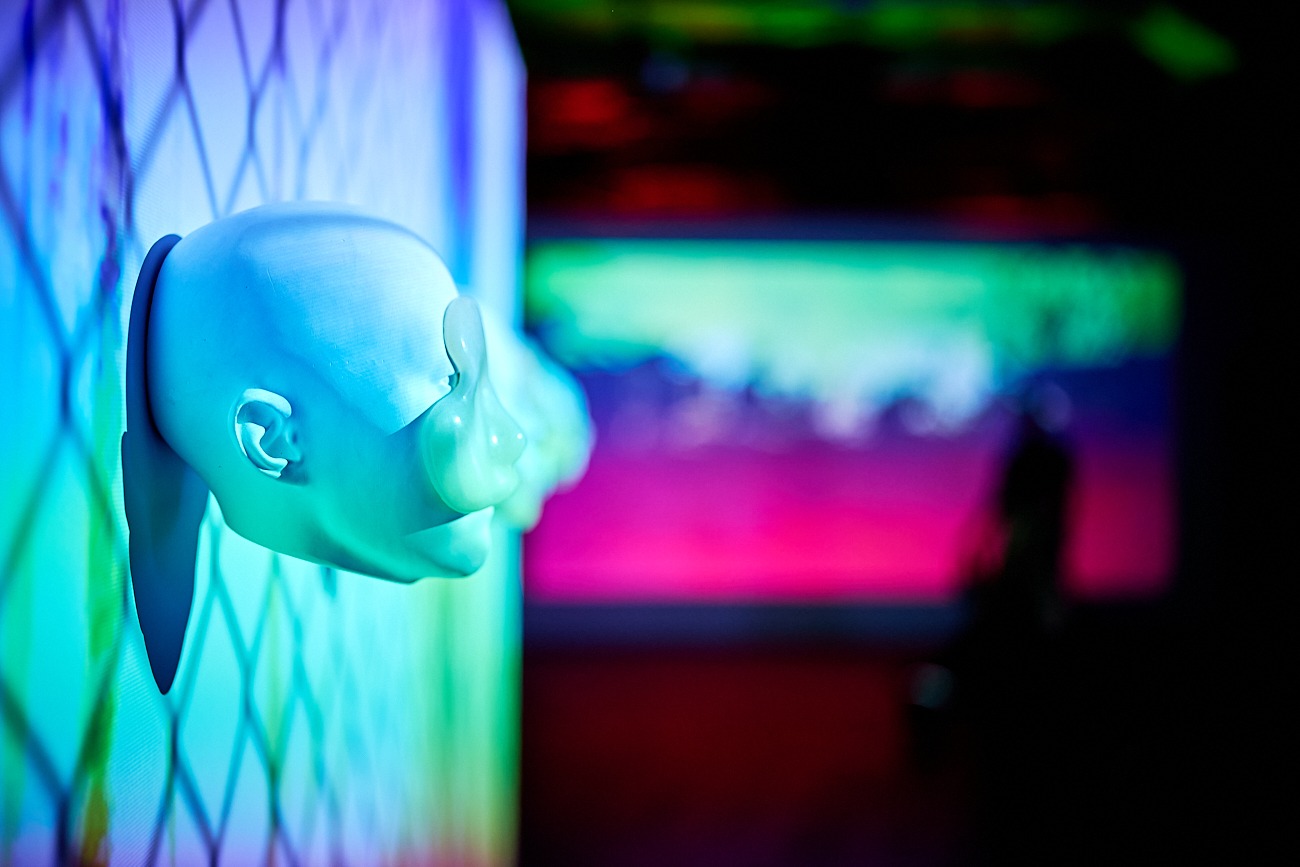
AI is also reshaping the very methodology behind trend forecasting.“There’s much more use of graphs, charts, and mathematical models now. One of the roles for humans is to conceptualise data by developing ideas about what you want to find out and how you present the results.”
A good trend forecaster, Woolford argues, is forged not only by skill but by time. “With time, you start to see patterns more clearly. It’s important to know fashion history, to understand how things evolve, where inspirations come from. It’s also about knowing how to be the right person at the right time, and how to look at things in the right way.”
“AI can analyse products and consumers – what people buy, what they don’t buy, why they buy, why they don’t, what items they return – and forecast what they are likely to buy next, even down to the individual level.”
Expert advice: be vigilant about who you consent to sharing your data with.
In a world driven by aggregated data, a Hegelian counter-movement is emerging alongside AI: a return to craftsmanship. “Whenever you have a trend, you also have an anti-trend. There will be renewed investment in craftsmanship, partly as an antidote to technology. People get tired of screens. Things created by technology have different aesthetics; AI-generated images often look too ‘polished’. People want something with a human touch,” says Woolford. “But there will be space for both.”
“Whenever you have a trend, you also have an anti-trend. (…) But there will be space for both.”
The idea of a locally crafted product, supported by compelling storytelling, has gained traction in both the luxury and sustainable fashion sectors. What is particularly interesting is that digital working models have enabled local communities to reach global audiences – creating an international presence that would have been impossible without technology.
FUTUREMODE and Poland’s Moment for Innovation
In what Woolford describes as “zeitgeist” – a shared spirit of the time – or simply a series of coincidences that feel almost fateful – she, along with Waldek Szymkowiak, choreographer, fashion show director, producer and director of Choreograffiti; Anna Syczewska, interdisciplinary artist and fashion designer; and Aleksandra Szymańska, director of the Creative Industries Institute (Instytut Przemysłów Kreatywnych), cultural manager, and strategist, found themselves discussing a shared goal: advancing the Polish fashion industry through technology, innovation, and interdisciplinary collaboration.
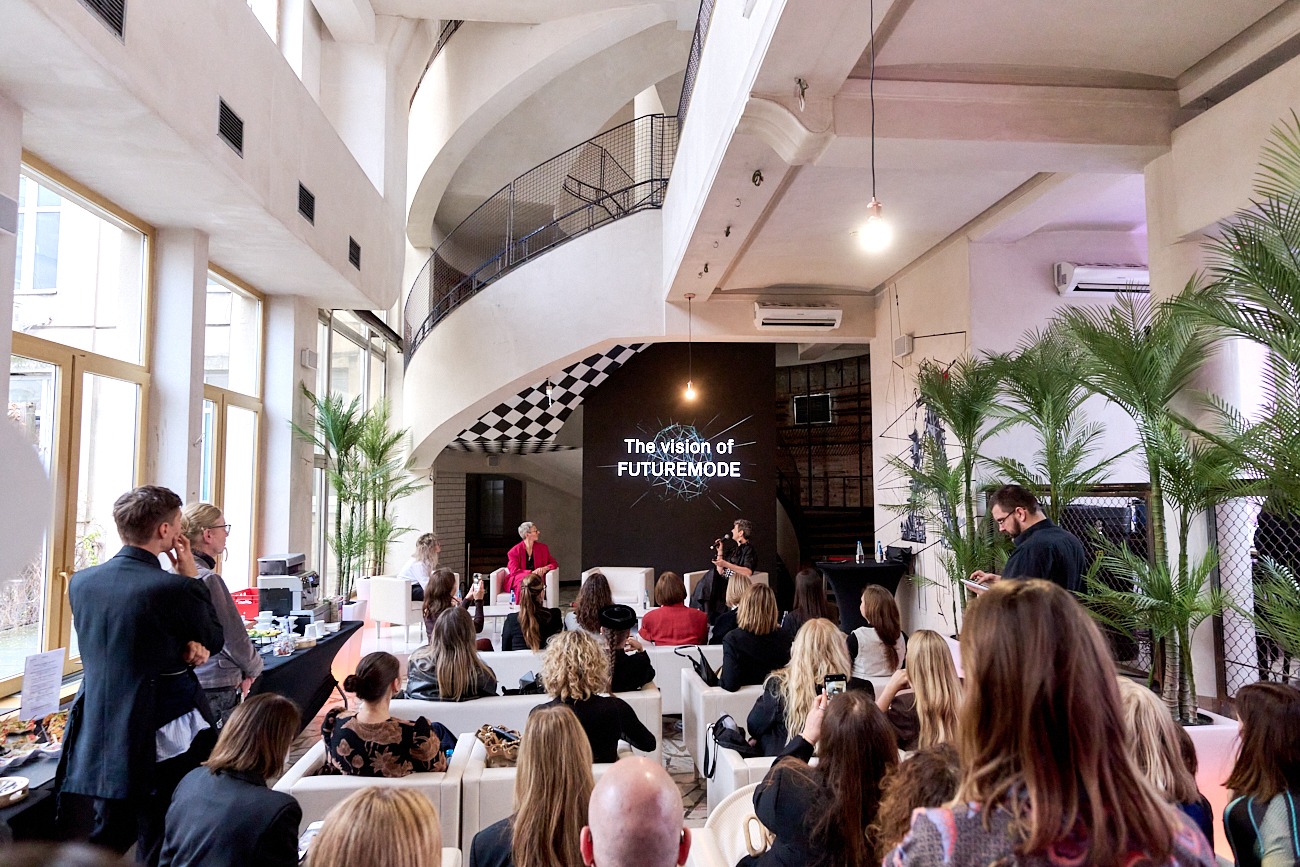
pc. Filip Okopny @FashionImages
“I love multidisciplinary projects. Innovation often comes from bringing new industries into fashion and learning what can be applied. We want to use different industries to innovate fashion,” says Woolford.
Launched on 15 December 2025, FUTUREMODE: The European Fashion Innovation Hub aims to provide local creatives with access to networking, technology, and global markets through innovative modes of presentation. Support will include the digitalisation of collections, access to digital fashion weeks and cross-industry events, and education, reflecting the collective background of all FUTUREMODE founders. Despite its digital focus, FUTUREMODE will operate both online and offline. Each space can be used separately or together in an augmented reality way, phygital or otherwise. “The digital world influences the real world, and vice versa. It’s a two-way street.”
With Woolford based in London, Szymkowiak in Cologne, Syczewska in Kraków, and Szymańska in Warsaw, the initiative will also build on the professional networks and relationships they have developed over decades.
When asked what success would look like for FUTUREMODE after its first year, Woolford says that seeing Polish designers’ work appear as skins in popular computer games, and watching them present their collections at major events through truly outstanding and innovative formats, would represent success.
Woolford is optimistic about Poland’s potential for innovation. History has forced Poles to develop an uncanny level of adaptability – and, as a result, a fondness for novelty. “The Polish thing,” she says, “is this: there’s something new – how can we use it? How can we adapt it? What can we do with it? Even when you look at the topics people in Poland discuss, they are often looking for uniqueness and novelty.”
“The digital world influences the real world, and vice versa. It’s a two-way street.”
Focusing on innovation and technology makes strategic sense, giving Poland an opportunity to compete in the global fashion landscape alongside established fashion centres such as France, the UK, and Italy. Poland is catching up quickly. AI, in particular, has made significant and tangible progress in the space and health industries over the past few years. In this context, Poland’s specific geopolitical position can also be leveraged as an advantage. “I have been observing the Polish fashion market for over 20 years. I have seen different approaches to putting Poland on the fashion map of Europe or the world – it hasn’t really happened yet. But the opportunity is there. There are two main avenues: innovation and acting as a bridge between Western, Central, and Eastern Europe. These are two areas where we can excel, and it’s possible,” says Woolford.
The Quantum Mind


In hindsight, one can’t help but think that what brought Woolford to where she is today – with FUTUREMODE serving both as a culmination and a new beginning – was set in motion over 20 years ago, when she started travelling back and forth between Poland and the UK for work projects, research, discussions, and interviews. Beyond her roles as trend forecaster and AI expert, Woolford is also an entrepreneur and cultural producer, having run a London pop-up shop featuring over 30 designers, co-produced a theatre play, and appeared in an art film premiered at the London Film Festival.
She also writes poetry and, since last year, has immersed herself in London’s alternative scene, exploring its community, music, fashion, make-up, and the whole alternative way of life (“hair is coming as well!”). Around the same time, she realised she had what she calls a “quantum mind”.
“Traditional computers are digital – zero or one, yes or no. Humans also like to label things that way. Quantum computers look at multiple possibilities at the same time until a final result appears. That’s how my brain works. I see many possibilities simultaneously, and the interactions between them.”
When asked about rest, Woolford acknowledges the importance of pacing herself, before reframing the idea entirely. “Resting, for me, is allowing life to flow. If there are no blockages, if you get the right pace, if you manage to notice every moment, life flows through you and for you – and then you do what you are meant to do. Even difficult tasks and challenges do not feel that hard. You still put lots of effort, time, and thinking into your job, but you discover more meaningful ways of working and doing, and this gives you more energy.”
Copy that.
***
ABOUT MARLENA WOOLFORD
Marlena Woolford is a London-based expert, consultant, lecturer, and journalist specialising in fashion, trend forecasting, AI, technology, and innovation. A graduate of the Warsaw School of Economics and CEMS (Community of European Management Schools) at Luigi Bocconi University in Milan, where she studied International Management, Woolford has worked with some of the most influential organisations in the global fashion industry, including WGSN, STYLUS, and various AI developers. She lectures at universities across Europe and has written, among others, for DASH Magazine, Hiro, Just4Textiles, Newsweek, and Retail Bulletin.
Picture courtesy of Marlena Woolford
Author

Discover more from Vegan Fashion Repository
Subscribe to get the latest posts sent to your email.