
The VFR Vegan Material Classification is an original, composition-led framework developed by Vegan Fashion Repository to map and distinguish the growing range of animal-free materials used in fashion. Drawing on material science, polymer chemistry and textile terminology, it brings together diverse material types in a structured, accessible overview.
The framework organises materials into three main tiers and seven subcategories, taking into account their feedstock origin, polymer identity, manufacturing process and, above all, the composition of the finished material. It covers fossil-derived synthetic polymers, regenerated and modified natural polymers, plant-based and bio-based composites, bio-based polymers, mineral-derived materials, established natural fibres and materials, and emerging plastic-free innovations.
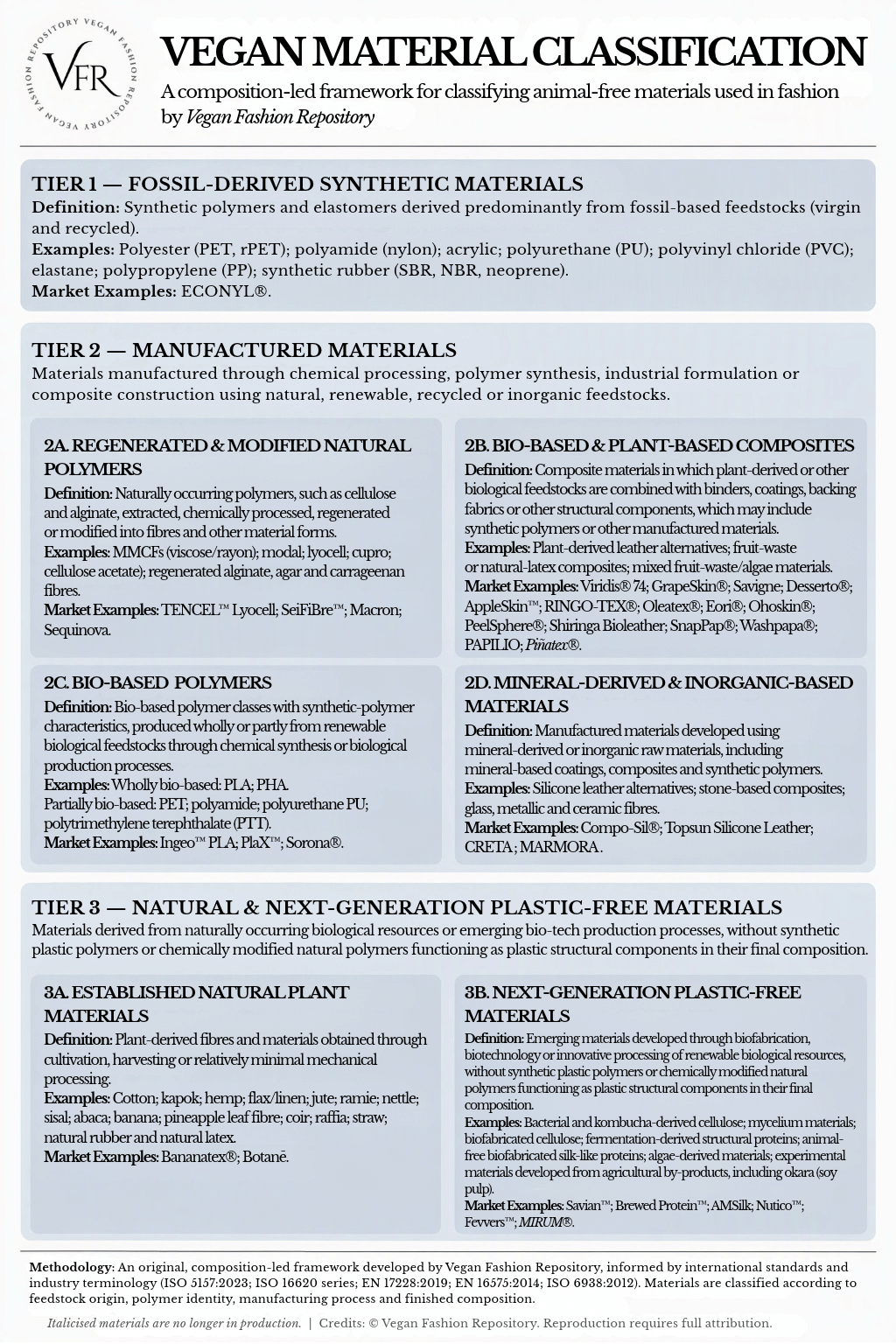
METHODOLOGY
The VFR Vegan Material Classification considers the complete composition and construction of each material, including constituent polymers, binders, coatings, backing layers, adhesives, finishes and other additives. Marketing terminology or the origin of a primary raw material alone is not sufficient to determine a material’s classification.
Particular attention is given to the distinction between natural, regenerated, chemically modified and synthetic polymers, as well as to the role they perform in the finished material. Chemical processing or modification does not automatically make a naturally occurring polymer a synthetic plastic. Conversely, a biological feedstock does not, in itself, establish that a material is plastic-free. Materials are assessed according to their resulting composition, chemical identity and function, including whether any polymeric component functions as a plastic structural element, binder, coating, film or backing layer.
The framework also distinguishes between polymer identity, feedstock origin and production route. Bio-based content, biodegradability and plastic-free status are separate characteristics and should not be inferred from one another. Composite materials are classified according to their complete construction, rather than the properties of individual constituents considered in isolation. The classification further distinguishes bio-based polymer classes with synthetic-polymer characteristics, classified under Tier 2C, from biofabricated structural materials based on biological polymers, classified under Tier 3B. This distinction takes into account the resulting polymer identity and material characteristics, rather than production route alone.
Animal-free eligibility is a prerequisite for inclusion and is assessed separately from material classification. The assessment considers animal-derived constituents, processing aids and other relevant production inputs, including substances that may not remain in the finished material.
Where complete composition or relevant manufacturing information is unavailable, classification or eligibility assessments remain provisional pending further verification. The framework is informed by international and European standards and industry terminology, including ISO 5157:2023, the ISO 16620 series, EN 17228:2019, EN 16575:2014 and ISO 6938:2012. These references provide supporting technical context; they do not define the VFR categories or constitute validation or certification of the framework.
The VFR Vegan Material Classification is intended as a practical reference for mapping and understanding the composition and development of animal-free materials. It is not an environmental performance ranking or an endorsement of the materials or manufacturers included.
SYNTHETIC PLASTIC POLYMERS
For the purposes of this framework, synthetic plastic polymers are industrially manufactured polymeric materials that function as structural, binding, coating or film-forming components. This includes synthetic polymers and elastomers used in these functions, as well as polymeric binders, coatings and backing layers incorporated into composite materials.
The classification distinguishes synthetic plastic polymers from naturally occurring polymers, including natural elastomers such as natural rubber. A polymer’s industrial processing or chemical modification does not, on its own, determine whether it is treated as a synthetic plastic polymer under this framework; its resulting identity and function in the finished material must also be considered.
PLASTIC-FREE CLASSIFICATION
A material is considered plastic-free when its final composition contains no synthetic plastic polymers or chemically modified natural polymers functioning as plastic structural components, including polymeric binders, coatings, films and backing layers.
The presence of a naturally occurring polymer, such as cellulose, starch, proteins, alginate or natural rubber, does not in itself disqualify a material from being classified as plastic-free. The distinction lies in the polymer’s resulting chemical identity, material form and function in the finished material. In particular, regenerated natural polymers are not automatically treated as synthetic plastics.
Chemical or physical processing alone does not automatically disqualify a naturally occurring polymer from plastic-free classification. Chemically modified natural polymers are assessed according to their resulting identity and function, rather than being automatically included or excluded as a class.
For example, cellulose acetate fibres are classified under Tier 2A as modified natural polymer materials and are not automatically excluded from plastic-free status. Cellulose acetate used as a thermoplastic matrix, film, coating or other plastic structural component, however, does not qualify as plastic-free. Similarly, thermoplastic starch used as a plastic matrix, film or coating is not considered plastic-free, despite its biological origin.
Vulcanisation of natural rubber is treated differently. Where vulcanisation is used to crosslink or cure natural rubber into an elastomer, this processing alone does not disqualify the material from Tier 3A or from plastic-free status. The presence of synthetic rubber, plastic binders, coatings or other disqualifying components must nevertheless be assessed separately.
COMPOSITE MATERIALS
Tier 2B is specifically reserved for plant-based and bio-based composites: composite materials in which plant-derived or other biological feedstocks are combined with binders, coatings, backing fabrics or other structural components. These additional components may be synthetic, bio-based, regenerated or otherwise manufactured.
The category includes composite constructions that combine biological feedstocks with manufactured components, rather than standalone polymers or materials classified under other categories. Standalone bio-based polymers fall under Tier 2C, while mineral-derived and inorganic-based materials fall under Tier 2D.
The classification of composites depends on their complete composition and the function of their constituent materials. The presence of synthetic plastic polymers or chemically modified natural polymers functioning as plastic structural components means that a composite does not qualify as plastic-free. Qualifying next-generation composites without these components may be classified under Tier 3B, while established natural materials and composites are placed in Tier 3A where appropriate.
The classification is determined by the complete composite construction rather than the eligibility or classification of its individual constituents in isolation. The presence and function of polymeric matrices, binders, coatings and other structural components are therefore assessed as part of the finished material.
BIO-BASED POLYMERS
Tier 2C encompasses bio-based polymer classes with synthetic-polymer characteristics, made wholly or partly from renewable biological feedstocks through chemical synthesis or biological production processes. Examples include polylactic acid (PLA) and polyhydroxyalkanoates (PHA), as well as partially bio-based versions of established synthetic polymer classes, such as PET, polyamide, polyurethane and polytrimethylene terephthalate (PTT).
The classification of these materials is based on their polymer identity and characteristics, rather than their production route alone. For example, PHA remains classified under Tier 2C even when produced through microbial biosynthesis. Its biological production route does not change its classification as a bio-based polymer within this framework.
Biosynthesis alone does not establish bio-based content. This depends on the origin of the carbon feedstock, which may be biological, fossil-derived or a combination of both. Where relevant, the bio-based content of a polymer is assessed separately from its production route and chemical identity.
BIOFABRICATED STRUCTURAL MATERIALS
Tier 3B includes composites without synthetic plastic polymers or chemically modified natural polymers functioning as plastic structural components and emerging materials produced through biofabrication, fermentation, biological growth or other biotechnology-enabled processes, where the resulting structural material is based on biological polymers such as cellulose or structural proteins. This includes recombinant proteins produced by engineered microorganisms, provided they retain their protein identity in the finished material and meet the plastic-free and animal-free eligibility requirements.
Examples include bacterial cellulose and biofabricated structural proteins, such as animal-free silk-like proteins produced through precision fermentation. Materials developed using these processes are distinguished from bio-based synthetic-polymer classes in Tier 2C according to their resulting polymer identity and material characteristics.
Production through fermentation or other biological processes does not, in itself, determine classification. The resulting material and its composition must be assessed. Accordingly, microbial production of PHA does not place it in Tier 3B, while biofabricated structural proteins that retain their biological polymer identity may qualify for this category.
ANIMAL-FREE ELIGIBILITY
Animal-free eligibility is a prerequisite for inclusion in the VFR Vegan Material Classification and is assessed independently of a material’s composition category or technological novelty. This assessment considers animal-derived constituents, processing aids and other relevant production inputs, including substances that may not remain in the finished material.
VERIFICATION AND LIMITATIONS
Where complete formulations or relevant manufacturing details are not available for assessment, classifications remain provisional pending further verification. Marketing terminology alone is not considered sufficient evidence of a material’s composition or its eligibility for a particular category. Relevant evidence may be assessed confidentially where necessary to protect proprietary information.
Composition classification and animal-free eligibility are assessed separately. Where available information is insufficient to establish either, the relevant assessment remains provisional until adequate evidence is obtained.
The classification is intended as a practical reference for understanding the diversity, composition and technological development of animal-free materials. It is not an environmental performance ranking and does not, in itself, constitute an endorsement of the materials or manufacturers listed.
INTERNATIONAL AND EUROPEAN STANDARDS
The following international and European standards provide supporting references for terminology, material characterisation, bio-based content measurement and environmental assessment. They inform the technical context of the VFR framework but do not establish its tier structure, classification criteria or eligibility requirements. The VFR Vegan Material Classification is an independent framework and has not been validated or certified against these standards.
1. Textile terminology and natural fibres
- ISO 5157:2023 — Textiles — Environmental aspects — Vocabulary.
- ISO 6938:2012 — Textiles — Natural fibres — Generic names and definitions.
2. Bio-based polymers and plastics
- ISO 16620 series — Plastics — Biobased content:
- ISO 16620-1:2015 — General principles.
- ISO 16620-2:2019 — Determination of biobased carbon content.
- ISO 16620-3:2015 — Determination of biobased synthetic polymer content.
- ISO 16620-4:2024 — Determination of biobased mass content.
- ISO 16620-5:2017 — Declaration of biobased carbon content, biobased synthetic polymer content and biobased mass content.
- EN 17228:2019 — Plastics — Bio-based polymers, plastics, and plastics products — Terminology, characteristics and communication.
The ISO 16620 series provides methods and principles for determining and declaring bio-based content in plastics. It serves as a supporting reference for bio-based content assessment but does not define the VFR Bio-based Polymers category, which encompasses a broader range of polymer types, including polymers produced through biological synthesis, such as PHA. In particular, ISO 16620-3 addresses bio-based synthetic polymer content in plastics and should not be interpreted as a method for determining the bio-based content of every type of polymer covered by the VFR category.
3. Bio-based product terminology and assessment
- EN 16575:2014 — Bio-based products — Vocabulary.
- EN 16785-1:2015 — Bio-based products — Bio-based content — Part 1: Determination of the bio-based content using radiocarbon analysis and elemental analysis.
- EN 16785-2:2018 — Bio-based products — Bio-based content — Part 2: Determination of the bio-based content using the material balance method.
4. Additional supporting standards
- EN 16640:2017 — Bio-based products — Bio-based carbon content — Determination of the bio-based carbon content using the radiocarbon method.
- EN 16751:2016 — Bio-based products — Sustainability criteria.
- EN 16760:2015 — Bio-based products — Life Cycle Assessment.
EN 16751 provides a framework of environmental, social and economic sustainability criteria applicable to the bio-based part of bio-based products. It does not cover non-bio-based components of partly bio-based products, establish universal sustainability thresholds or, in itself, substantiate claims that an entire product or operation is sustainable.
EN 16760 provides life cycle assessment requirements and guidance for bio-based products, supporting the assessment of their environmental impacts. It does not constitute a criterion for material classification.
These standards are included as supporting technical references and should not be interpreted as evidence of environmental performance, sustainability, biodegradability, plastic-free status or animal-free eligibility.